Best AI Freight Forwarding Software in 2026 (Top 11 Compared)
Author:
Priyanka
Published On:
1 min read
This comparison covers software platforms, not freight forwarding companies. Every product below is a system a forwarding team would use to run or automate its work.
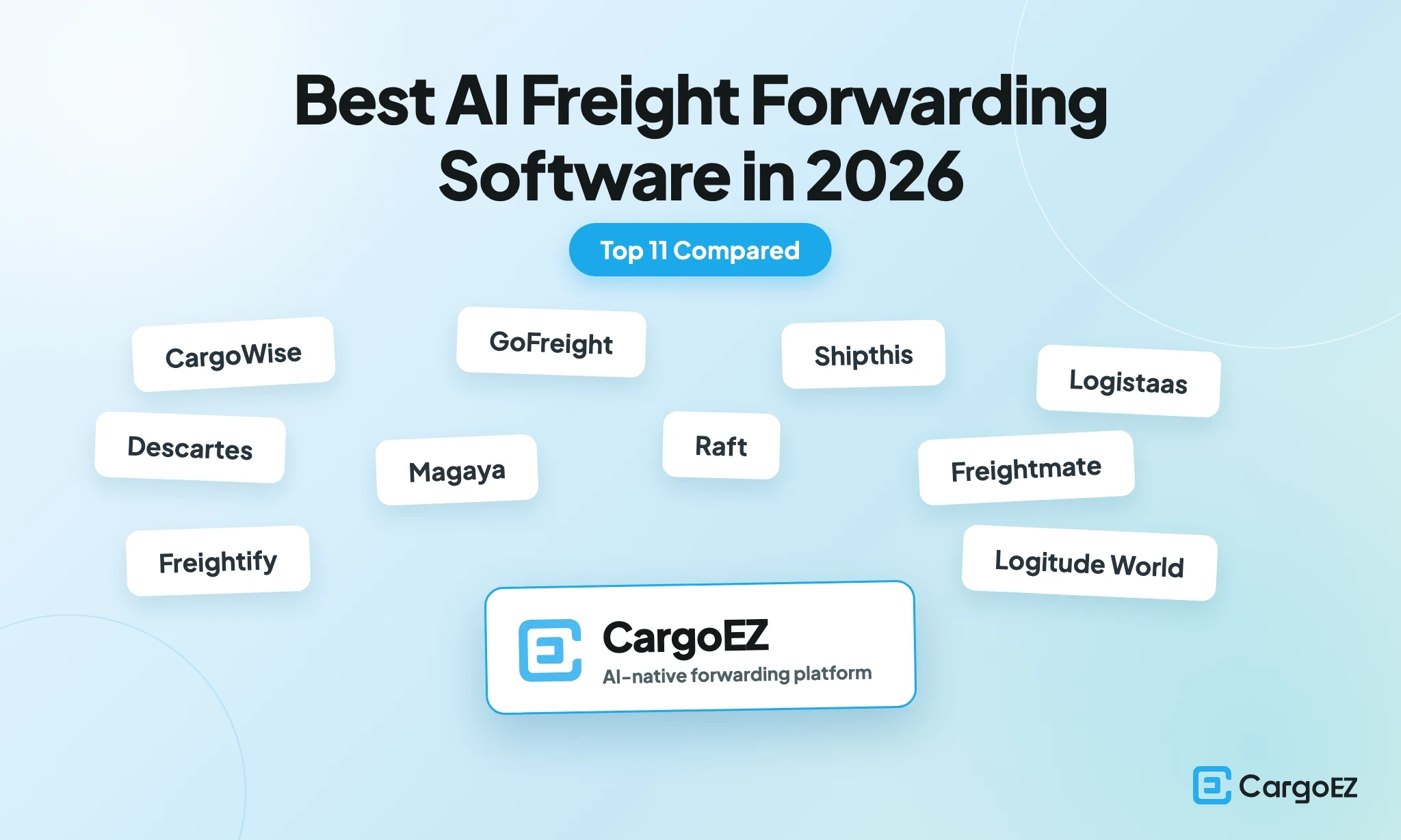
Comparing the top 11 best AI freight forwarding software platforms includes 1. CargoEZ, 2. GoFreight, 3. Shipthis, 4. CargoWise, 5. Logistaas, 6. Descartes Forwarder Enterprise Suite, 7. Magaya Supply Chain, 8. Raft, 9. Freightmate, 10. Freightify, and 11. Logitude World.
Best AI Freight Forwarding Software at a Glance
CargoEZ: Best for US-focused SMB forwarders wanting AI-automated enquiry handling across connected rates, operations, finance, and compliance workflows.
CargoWise: Best for large, multinational, and operationally complex forwarding businesses.
Logistaas: Best value shortlist for built-in document AI with public per-user pricing.
Descartes: Best for compliance-heavy, multi-office, and enterprise forwarding operations.
Magaya: Best for forwarders that also need warehouse and inventory workflows.
GoFreight: Best all-round shortlist for SMB and midsize forwarders prioritising usability and accounting connectivity.
Shipthis: Best for buyers wanting a full platform with a published base price and 30-day trial.
Raft: Best for larger forwarders adding AI orchestration around an existing core system.
Freightmate: Best for focused document extraction, customs-entry preparation, and AP automation.
Freightify: Best for carrier-rate procurement, rate management, and faster quoting.
Logitude World: Best for SMB forwarders wanting a broad cloud platform with optional Document AI.
What AI Freight Forwarding Software Actually Fixes
The operational problems these products are designed to remove are straightforward:
Shipment documents and emails are re-keyed into operating systems.
Quotes are delayed while teams search scattered carrier rate sheets.
Exceptions and customs tasks are tracked across inboxes and spreadsheets.
Carrier invoices are not checked against expected costs before billing.
Customers ask for shipment updates that already exist somewhere in the operation.
These are administrative bottlenecks, and they force forwarders to add headcount just to handle more volume.
Full Forwarding Platforms vs Specialist AI Layers
The products fall into two categories:
Full forwarding platforms manage several workflows in one system of record. CargoEZ, GoFreight, Shipthis, CargoWise, Logistaas, Descartes, Magaya, and Logitude fall into this group.
Specialist AI layers connect to an existing platform and automate a narrower workflow. Raft, Freightmate, and Freightify fall into this group.
My short rule is simple: if the current forwarding platform is the bottleneck, evaluate a replacement. If one workflow is consuming the team's week while the core system still works, evaluate a specialist layer.
My Picks: Best AI Freight Forwarding Software
Platform | Best for | Starting price | Implementation evidence | Evaluation access | Rating |
US-focused SMB forwarders needing AI-assisted enquiry handling across connected operations, finance, and compliance | |||||
Large multi-entity global forwarding operations | Published transaction rates | Partner-led and scope-dependent | Demo | ||
SMB forwarders wanting built-in AI and public per-user pricing | Custom quote | Vendor states weeks; scope-dependent | Demo; trial terms not clearly published | ||
Compliance-heavy enterprise forwarding operations | Custom quote | Demo | |||
Forwarders that also operate warehouses or inventory | Custom quote | Vendor guidance: 30–90 days | Demo | ||
SMB and midsize forwarders prioritising usability and integrations | Custom quote | Vendor guidance: 4–8 weeks; G2 average about 2 months | Demo | ||
Growing forwarders wanting a priced, trial-ready full platform | Custom quote | Vendor wording: about 8–9 weeks | 30-day free trial | ||
AI automation around an existing core platform | Custom quote | Vendor says workflows can deploy in days; full scope varies | Demo | No public G2/Capterra rating located | |
High-volume document, customs-prep, and AP automation | Custom annual and usage terms | Vendor says proof of concept can start in days | Proof of concept | No public G2/Capterra rating located | |
Rate procurement, rate management, and quote speed | Custom packages; transaction fees may apply | 7-day free trial | |||
SMB forwarders wanting a broad platform with optional Document AI | From $75/user/month annually | Vendor says standard setup can begin in a few days | 7-day free trial |
Ratings and review counts are snapshots checked on August 2026 and can change. “No public rating located” means I could not substantiate an exact-product profile on G2 or Capterra at the time of review.
How I Evaluated These 11 Platforms
I reviewed current product documentation, pricing, integrations, security information, implementation materials, demos, and G2 or Capterra reviews. Product details come from first-party sources, while user experience comes from independent reviews. Vendor-reported claims are clearly labelled, and unavailable information is marked as not publicly disclosed.
CargoEZ publishes this comparison and appears in it. I applied the same evaluation standards to every platform. CargoEZ is included as a full freight forwarding management system whose AI runs inside that workflow rather than alongside it, beginning with AI-powered automated enquiry management at the head of the shipment lifecycle.
Every platform was checked against the same seven questions:
Does it read your documents right the first time? The share it gets correct with nobody fixing them afterwards.
Is the AI built in, or bolted on? Inside the system running your shipments, or sitting outside and pushing data into it.
Does it do the work, or just help you do it? Summarising a document is not the same as building the invoice.
What does it cost, and how fast does it run? Flat fee, per seat, or per shipment, and days or months to go live.
Can it file US customs? AMS and ISF, both ISF-5 and ISF-10+2, plus denied party screening.
Where is the shipment right now, and who can see it? Milestone and carrier status inside the platform, across every mode you actually run, including road or door-to-door if that's part of your operation.
What does your customer actually see? A portal they can use themselves, or another email to your operations team.
How much of quote-to-cash sits in one system? One platform, or three tools and a spreadsheet.
These seven questions make up the Seven-Gate Test explained later in the article.
Evaluation Criteria
Evaluation area | What I checked | Public evidence across 11 products |
Document automation | Supported documents, extraction confidence, validation, and human review | Only 1 of 11 publishes an accuracy figure: Freightmate’s vendor-reported 99% |
Integration and workflow | Native workflows, APIs, webhooks, EDI, and accounting connections | Integration depth varies and should be tested at field level |
Operational and quoting depth | Record creation, task routing, rate management, quotes, invoice reconciliation, and updates | Buyers should verify what the AI executes rather than only assists with |
Exception handling | Mismatch alerts, confidence thresholds, approvals, ownership, and audit trails | Test with the same real documents and exception cases for every vendor |
Cost and implementation | Licences, usage fees, add-ons, migration, training, and go-live time | 4 of 11 publish numeric pricing; 3 of 11 publish clear free-trial terms |
Shipment visibility and tracking | Milestone updates, carrier and vessel status, ETD and ETA handling, mode coverage, and customer-facing tracking | Tracking depth varies sharply by mode; confirm road or door-to-door coverage separately from air and ocean |
Security and compliance | Certifications, access controls, customs scope, support, and customer portals | 5 of 11 publish named security certifications or attestations |
Independent validation | G2 or Capterra rating, review count, and recurring user feedback | 8 of 11 have an exact-product G2 rating; 9 of 11 have a G2 or Capterra rating |
There is no universal 97% accuracy benchmark that makes one tool production-ready. The useful test is first-pass performance on the buyer's own documents. Ask each vendor to report field-level accuracy, the percentage of files needing human correction, confidence thresholds, and exception handling on the same controlled batch.
Detailed Comparison
1. CargoEZ
Best for: US-focused small and midsize freight forwarders that want CRM, rates, shipment operations, finance, and customs and compliance workflows in one freight forwarding management system.
Starting price: Custom quote based on modules and requirements; no public numeric starting price.
Quick fact | Verified detail |
Best for | US-focused SMB air and ocean freight forwarders |
Starting price | Custom quote |
Implementation | |
Rating | |
Trial or demo | Demo; no public free-trial terms located |
Type | Full freight forwarding management system; AI-native release announced |
CargoEZ is an AI freight forwarding management system built around workflow continuity. Walk a single file through it and the sequence runs enquiry, rate request, rate comparison, quote, approval, booking, shipment, exception, customer update, billing, and profitability. In most forwarding operations that same sequence spans three or four systems and gets retyped at least twice along the way. Here it stays one record.
The AI sits at the front of that chain. CargoEZ applies AI-powered automated enquiry management, so an inbound enquiry is captured and moved into the rate and quoting workflow instead of being logged by hand, which is the step most forwarding systems still leave manual. The platform carries G2's AI Enabled designation, and compliance work further down the chain is automated rather than assisted. AMS and ISF filing run inside the shipment workflow, denied party screening checks against OFAC and BIS, and air waybills generate in under 60 seconds.
Pros
AMS and ISF filing built into the shipment workflow, covering both ISF-5 and ISF-10+2
Denied party screening against OFAC and BIS lists
Air waybill generation in under 60 seconds
Milestone tracking across air and ocean shipments, with ETD/ETA, carrier and port status, and visibility from first mile to last
Built-in accounting with a QuickBooks API connection, so you can run finance inside the platform or keep your existing books
Customer portal with multi-language support and customizable user roles, which sits above the usual SMB baseline
Covers the quote-to-cash lifecycle in one forwarding-specific system
Cons
Air and ocean only, so forwarders needing road or door-to-door coverage should look elsewhere
Pricing requires a sales conversation
Customs is a workflow capability rather than a direct ACE portal integration
Spot-rate procurement and road or door-to-door tracking aren't part of the current scope, though both are planned for CargoEZ's V2.0
Snapshot
Field | Detail |
Overview | Freight forwarding workflows spanning CRM, contract rates, quotes, bookings, air and ocean shipments, finance, customer updates, and compliance tasks |
AI approach | AI-powered enquiry management at the front of the workflow, with automated AMS/ISF filing, denied-party screening, and sub-60-second air waybill generation downstream. |
Product type | Full freight forwarding management system |
Security and compliance | CargoEZ lists AICPA SOC 2, ISO 27001, GDPR, TLS 1.2+, AES-256 encryption, access controls, backups, and disaster recovery across its site and terms |
Integrations | QuickBooks API connection confirmed by the product team; the public integration documentation should be expanded |
Specialisation | Air and ocean workflows for US-focused freight forwarders, including AMS and ISF process support |
Implementation | G2 reports an average under one month; scope and migration complexity still determine the actual project |
Support | Guided onboarding, training, and live support are described publicly; no response-time SLA is published |
Tool features
The following product scope combines current public information with a CargoEZ demo-tenant walkthrough supplied by the product team on August 2026:
Contacts and leads: contact management, portal users, powers of attorney, custom fields, inbox-based lead handling, sales funnel reporting, and air or ocean opportunities
Rates and quoting: air and FCL contract-rate search, comparison, quote creation, and FMC-related workflows; spot-rate procurement is not currently included
Freight operations: bookings, air and ocean shipments, FCL and LCL records, AWB and eAWB workflows, Incoterms, owners, status, ETD and ETA, reporting, and port-to-port vessel tracking
Customer portal: real-time shipment tracking by BL, container, or AWB, quotation-to-invoice visibility, integrated messaging between shippers and consignees, and multi-language support with customizable user roles
Finance: chart of accounts, banking, estimates, receivables, payables, expenses, ageing reports, job-level P&L, and multi-currency workflows
Customs workflow: AMS and ISF document workflows. The customs area was beta in the supplied demo tenant, and direct ACE portal integration is not currently exposed, so filing transmission should be demonstrated
Administration and collaboration: role-based access, users, roles, templates, picklists, locations, currencies, and internal team chat
Accounting connectivity: QuickBooks API connection, confirmed by the CargoEZ product team but not yet documented clearly on the public integration pages
What it costs
Plan | Price | Key inclusions |
Configured CargoEZ subscription | Price depends on selected modules and requirements; monthly, quarterly, half-yearly, and annual billing are listed |
No numeric starting price or public free-trial terms were available when checked. Ask for implementation, migration, integrations, support, AI access, and any customs-related fees to be itemised separately.
Best fit for
A US-focused SMB forwarder running air and ocean operations that wants CRM, contract rates, quoting, shipment execution, finance, customer communication, and compliance workflows connected in one platform.
Not built for
A forwarder that requires road or door-to-door tracking, spot-rate procurement, or published document-extraction benchmarks before buying. The first two are planned for CargoEZ's V2.0.
What users are saying
CargoEZ has a 4.8/5 G2 rating from 40 reviews, tied for the highest score in this comparison. Recent reviews commonly mention ease of use, migration support, and responsive service. The sample is solid for an SMB product, though smaller than the longest-established platforms here. I would use the reviews as support evidence, then test the specific rate, customs, and accounting workflows that matter to the operation.
Our Verdict: CargoEZ is a strong shortlist choice for US-focused SMB forwarders that want quote-to-cash continuity, finance, and compliance workflows in one freight forwarding management system. I would choose it when connected operations and AMS/ISF filing matter more than road tracking or spot-rate procurement. Ask in the demo what the AI automates today, and where the V2.0 roadmap takes quoting, document processing, and pricing.
2. CargoWise
Best for: Large, multinational, and operationally complex forwarders that need broad global execution, customs, accounting, and compliance coverage.
Starting price: Published transaction rates vary by workflow, mode, and Value Pack.
Quick fact | Verified detail |
Best for | Large multi-entity global forwarding operations |
Starting price | Public transaction schedule; no single per-user starting price |
Implementation | Partner-led and scope-dependent |
Rating | |
Trial or demo | Demo and sales consultation; no public free trial located |
Type | Enterprise global logistics execution platform |
CargoWise is the enterprise benchmark in this category, with the broadest global operating footprint in the shortlist. WiseTech says the platform supports 17,000 organisations across 193 countries, 30 languages, and 162 currencies. Its strength is not a single AI feature. It is the combination of forwarding, customs, compliance, finance, warehousing, global data, and partner connectivity in one enterprise environment. CargoWise Value Packs added AI document ingestion and began rolling out additional AI and agentic capabilities from December 2025.
CargoWise now publishes community transaction pricing. As one example, the August 2026 schedule lists forwarding export transactions at $12.75 for FCL or FTL and $8.35 for LCL, LTL, air, or non-FCL; import transactions are $19.95 and $13.30 respectively. Applicability varies by workflow and Value Pack, so buyers should use the current pricing schedule rather than a single “per user” estimate.
Pros
Widest global and enterprise execution scope in this list
Deep customs, compliance, accounting, and multi-entity capabilities
AI is being added to an established global system of record
Public transaction pricing is more transparent than the old quote-only perception
Cons
Complex implementation, configuration, training, and governance requirements
Transaction pricing requires careful volume modelling
Steeper learning curve than SMB-focused platforms
G2 review count is relatively modest for the platform's market footprint
Snapshot
Field | Detail |
Overview | Global forwarding, customs, compliance, finance, warehouse, data, and partner-network execution |
Scale | WiseTech reports 17,000 organisations across 193 countries, 30 languages, and 162 currencies |
AI approach | Value Packs include AI document ingestion and an expanding set of AI and agentic capabilities |
Security | Current material references ISO 27001, SOC reporting, NIST alignment, penetration testing, and regular assessments |
Implementation | Partner-led, configuration-heavy, and dependent on countries, entities, integrations, and modules |
Support | 24/7 incident support plus a global implementation and service-partner network |
Tool features
Global forwarding operations: air, ocean, road, and multimodal job execution
Customs and compliance: country-specific customs, sanctions, and trade-compliance workflows
Finance and accounting: multi-entity, multi-currency operational finance in the same platform
Warehousing: connected warehouse and inventory workflows for complex logistics businesses
Document ingestion: AI-assisted extraction introduced through CargoWise Value Packs
Agentic functions: additional workflow agents rolling out as part of the Value Pack roadmap
Global data and connectivity: broad network, partner, carrier, and enterprise-system integration options
What it costs
Published example | August 2026 community rate | Scope note |
Forwarding export: FCL/FTL | $12.75 per transaction | Applicability depends on workflow and Value Pack |
Forwarding export: LCL/LTL/air/non-FCL | $8.35 per transaction | Applicability depends on workflow and Value Pack |
Forwarding import: FCL/FTL | $19.95 per transaction | Applicability depends on workflow and Value Pack |
Forwarding import: LCL/LTL/air/non-FCL | $13.30 per transaction | Applicability depends on workflow and Value Pack |
These examples are not a complete quote. Model every transaction type, module, partner service, implementation workstream, training requirement, and country rollout against expected volume.
Best fit for
A multinational forwarder that needs global execution, customs, accounting, compliance, and multi-entity control and can support a substantial implementation and change programme.
Not built for
A small forwarder whose priorities are a fast self-service trial, simple administration, low configuration overhead, or a predictable per-user subscription.
What users are saying
CargoWise has a 4.3/5 G2 rating from 35 reviews. Reviewers value its integration, global scope, and ability to centralise complex operations. The most consistent negatives are complexity, training burden, cost, and the depth of configuration required. In my view, it belongs on an enterprise shortlist, but is often excessive for a small forwarder seeking a fast replacement for spreadsheets.
Our Verdict: CargoWise remains the strongest enterprise choice when global scale, customs depth, multi-entity control, and compliance outweigh implementation simplicity. I would not put it on a small-forwarder shortlist without first modelling transaction costs and the organisational change required to use its breadth.
3. Logistaas
Best for: Small and midsize forwarders that want a cloud operating platform with built-in document and invoice AI and public per-user pricing.
Starting price: $45 per user/month for Sales Booster; implementation is extra.
Quick fact | Verified detail |
Best for | SMB forwarders wanting built-in AI and public per-user pricing |
Starting price | $45/user/month; broader packages reach $85/user/month |
Implementation | Vendor describes weeks; exact timing is scope-dependent |
Rating | |
Trial or demo | Demo; “try free” appears publicly, but terms and duration were not located |
Type | Full forwarding platform with built-in Averroes AI |
Logistaas is a full forwarding platform covering CRM, rate management, operations, finance, reporting, and customer experience. Its Averroes AI is documented as part of the platform and can read bills of lading, air waybills, and vendor invoices, identify shipment risks, support internal compliance checks, and guide users inside the application.
The pricing is also more transparent than most competitors. Current first-party tiers are $45 per user/month for Sales Booster, $65 for Operations Engine, and $85 for Customer Experience or the all-in-one accounting package. A one-time implementation fee is additional.
Pros
Built-in AI is documented against specific forwarding documents and workflows
Public per-user pricing makes early budget comparison easier
Broad finance and integration coverage for an SMB platform
Faster vendor-stated implementation than many enterprise products
Cons
Only two G2 reviews were available, and both were incentivised, so the rating is not a reliable market sample
Free-trial terms are not clearly published
Reviews mention integration, customisation, occasional lag, and support limitations
A one-time implementation fee sits outside the advertised monthly price
Snapshot
Field | Detail |
Overview | Cloud forwarding platform for CRM, rates, shipment operations, finance, reporting, and customer experience |
AI approach | Averroes AI reads common forwarding documents, flags shipment risk, supports internal compliance, and assists users in the application |
Integrations | QuickBooks, Xero, SAP, Dynamics, Sage, Zoho, Tally, INTTRA, Traxon, Descartes, Chain.io, and others |
Security | SOC 2 Type 1 is displayed publicly; hosting and controls are described on the product site |
Implementation | Vendor describes implementation in weeks; one-time implementation fee applies |
Review evidence | Only two G2 reviews were available, both incentivised |
Tool features
CRM and sales: customer, opportunity, rate, and quotation management
Forwarding operations: shipment records and workflows across common transport modes
Averroes document AI: extraction from bills of lading, air waybills, and vendor invoices
Risk and compliance assistance: shipment-risk flags and internal compliance checks
Finance: forwarding accounting, billing, and financial reporting options
Customer experience: portal and communication workflows in the broader packages
Integrations: accounting, carrier, connectivity, and logistics-network partners
What it costs
Package | Price | Primary scope |
Sales Booster | $45/user/month | CRM, rates, and sales workflows |
Operations Engine | $65/user/month | Operational forwarding workflows |
Customer Experience | $85/user/month | Broader customer-facing scope |
All-in-one accounting package | $85/user/month | Integrated accounting scope |
A one-time implementation fee is additional. Confirm billing cadence, AI entitlements, integrations, migration, support, and any cross-package requirements in the final quote.
Best fit for
An SMB forwarder moving off spreadsheets or fragmented software that wants forwarding operations and document AI with a relatively understandable per-user budget.
Not built for
A risk-averse buyer that requires a large independent review base, clearly published trial terms, or a zero-services self-implementation.
What users are saying
Logistaas has a 4.5/5 G2 rating, but it is based on only two incentivised reviews. Those reviews praise ease of use and automation while also mentioning integration and customisation challenges. I would not use the score to rank the product. A paid proof of concept or reference call would carry more weight.
Our Verdict: Logistaas is a credible value shortlist for forwarders that want built-in document and invoice AI with understandable per-user pricing. I would not let its two-review G2 score carry the decision; a workflow proof and customer reference are essential.
4. Descartes Forwarder Enterprise Suite
Best for: Compliance-heavy, multi-office, and enterprise forwarders that need shipment management, accounting, customs, screening, tracking, and global connectivity.
Starting price: Custom quote; no public numeric Forwarder Enterprise price located.
Quick fact | Verified detail |
Best for | Compliance-heavy and multi-office enterprise forwarding operations |
Starting price | Custom quote |
Implementation | G2 average: about 2 months; larger multi-module projects vary |
Rating | |
Trial or demo | Demo and on-demand material; no public free trial located |
Type | Enterprise broker and forwarder suite with connected automation modules |
Descartes is a broad broker and forwarder ecosystem rather than one simple AI product. The Forwarder TMS and OneView products cover multimodal shipment management, accounting, tracking, reporting, documentation, and customer access. Connected Descartes modules add customs, security filing, denied-party screening, global price management, and other specialist capabilities.
The product documentation includes automated data entry and extraction, while Descartes' wider network increasingly uses data and AI. I would describe it as an enterprise forwarding suite with automation and connected AI capabilities, not as a single AI-native application.
Pros
Deep customs, regulatory, screening, and global logistics network coverage
Modular product range can support complex forwarder and broker operations
Stronger named security evidence than most products in the category
Exact-product G2 profile with a meaningful review sample
Cons
Pricing is not public
Buyers must define which Descartes products and add-ons are actually in scope
The AI story is distributed across products rather than one simple native layer
Reviews mention a dated or field-heavy interface and occasional technical issues
Snapshot
Field | Detail |
Overview | Broker and forwarder systems for multimodal shipments, accounting, tracking, documentation, customs, and compliance |
AI and automation | Automated data entry and extraction plus data-driven functions distributed across connected Descartes products |
Compliance depth | Customs, security filing, denied-party screening, and other specialist trade-compliance modules |
Security | Current ESG disclosure references ISO 27001 certification, SOC 2 Type II reports, NIST alignment, annual audits, and risk assessments |
Implementation | G2 average is approximately two months; multi-office and multi-module projects can be longer |
Support | Local domain specialists and product-specific support contacts are documented |
Tool features
Forwarder operations: multimodal shipment planning, documentation, milestones, and execution
Accounting and reporting: financial, operational, and management reporting within the suite
Customs and regulatory: connected customs, filing, trade-security, and denied-party-screening modules
Global price management: rate and pricing support within the wider Descartes portfolio
Customer access: tracking, document, and self-service visibility options
Automation: data extraction and automated entry in selected products and workflows
Network connectivity: access to Descartes' broader logistics-data and messaging ecosystem
What it costs
Plan | Price | Key inclusions |
Configured Descartes suite | Custom quote | Forwarder Enterprise scope plus selected customs, compliance, screening, price-management, visibility, or network modules |
Request a product-by-product quote. “Descartes” can describe several connected products, so implementation, integrations, message volume, support, and each required compliance module should be itemised.
Best fit for
An enterprise or multi-office forwarder whose decision is driven by customs, regulatory controls, screening, global connectivity, and a broad logistics ecosystem.
Not built for
A small team seeking one simple AI-native product, a published entry price, a self-service trial, or a lightweight implementation.
What users are saying
Descartes Forwarder Enterprise Suite has a 4.2/5 G2 rating from 53 reviews. Users value centralised shipment control, tracking, support, and established domain coverage. The common cautions concern interface complexity, required fields, and technical glitches. That makes workflow design and user acceptance testing important before a broad rollout.
Our Verdict: Descartes is a strong enterprise shortlist for forwarders whose decision is driven by customs, regulatory compliance, screening, and network connectivity. I would choose it for that depth, not for simplicity, price transparency, or a single AI-native user experience.
5. Magaya Supply Chain
Best for: Forwarders that also run warehouse, inventory, fulfilment, or customs brokerage workflows.
Starting price: Custom quote; no current public numeric starting price located.
Quick fact | Verified detail |
Best for | Forwarders that also operate warehouses or inventory workflows |
Starting price | Custom quote |
Implementation | Vendor guidance: 30–90 days; G2 average near 3 months |
Rating | |
Trial or demo | Demo; no current verified public free-trial terms located |
Type | Full logistics platform combining forwarding and warehouse operations |
Magaya's differentiator is the combination of forwarding and warehouse operations. Magaya Supply Chain covers quotes, bookings, receiving, shipments, documents, warehousing, accounting, tracking, and APIs in one system of record.
AI is more modular than universal across the platform. For example, Magaya's customs products use AI to extract commercial-invoice data and support tariff classification, while other modules focus on workflow automation and connectivity. A buyer should ask which AI features are included in the proposed configuration rather than assume every Magaya screen is AI-driven.
Pros
Strongest forwarding-plus-warehouse fit in this comparison
Largest public review base among the 11 products
Broad operations, accounting, customs, visibility, and integration ecosystem
Published 30-to-90-day implementation guidance
Cons
Pricing is not public
AI capabilities are spread across modules and may require add-ons
Pure forwarders may pay for warehouse depth they do not need
Reviews mention performance, support, and data-quality issues in some deployments
Snapshot
Field | Detail |
Overview | Logistics platform combining forwarding, warehouse, inventory, finance, customs, tracking, and API workflows |
AI approach | Modular AI in selected workflows, including customs invoice extraction and classification assistance |
Warehouse depth | Receiving, inventory, storage, warehouse operations, and fulfilment alongside forwarding |
Security | Cloud hosting and encryption aligned with SOC 1 and SOC 2 requirements are described; I did not locate a current product-level certification report |
Implementation | Vendor guidance is 30–90 days; G2 average is near three months |
Support | Phone and email support, assigned specialists, professional services, implementation, and training |
Tool features
Forwarding: quotes, bookings, shipment execution, documents, milestones, and tracking
Warehouse and inventory: receiving, storage, movement, fulfilment, and inventory control
Finance: forwarding accounting and job-related financial workflows
Customs: connected customs products, including selected AI extraction and classification assistance
Customer visibility: tracking and portal capabilities in the Magaya ecosystem
Connectivity: APIs and partner integrations for surrounding logistics systems
Reporting: operational and financial reporting across forwarding and warehouse work
What it costs
Plan | Price | Key inclusions |
Configured Magaya subscription | Custom quote | Supply Chain platform plus selected forwarding, warehouse, customs, visibility, accounting, integration, and service modules |
Ask for the full first-year cost across licences, warehouse or customs modules, implementation, migration, training, integrations, and support. Pure forwarders should identify which warehouse-related scope can be excluded.
Best fit for
A forwarder that genuinely manages freight and warehouse or inventory operations and wants both areas connected to finance, customs, and customer visibility.
Not built for
A pure forwarding team that wants the lightest operating system, a public entry price, or AI embedded consistently across every module.
What users are saying
Magaya Supply Chain has a 4.4/5 G2 rating from 290 reviews, the strongest review-volume signal in this comparison. Users value the integrated forwarding and warehouse scope. Recurring criticisms concern speed, support responsiveness, data handling, and complexity in some environments. For a warehouse-forwarder, the product deserves a serious trial; for a pure forwarder, the extra breadth may not justify the cost.
Our Verdict: Magaya is the clearest choice here for a forwarder that genuinely needs warehouse and inventory depth alongside forwarding. I would only select it for a pure forwarding operation after proving that the extra scope does not add unnecessary cost and administration.
6. GoFreight
Best for: SMB and midsize forwarders prioritising usability and integrations
Starting price: Custom quote; no public numeric starting price located.
Quick fact | Verified detail |
Best for | SMB and midsize forwarders prioritising usability and integrations |
Starting price | Custom quote |
Implementation | Vendor guidance: 4–8 weeks; G2 average about 2 months |
Rating | |
Trial or demo | Demo; no clear public free-trial terms located |
Type | Full forwarding platform with in-platform AI workflows |
GoFreight is one of the clearest full-platform options in this list. Its current platform overview documents an Action Center, GoNexus Email Intake, GoNexus Hub, and AI-assisted rate management inside the forwarding platform rather than as a separate extraction portal.
The product covers air and ocean forwarding, shipment tracking, documents, accounting and billing, customer visibility, and multi-office workflows. Its integration documentation lists 125-plus carrier connections, REST APIs, webhooks, EDI, two-way QuickBooks Online and Desktop connectivity, and API options for Sage, NetSuite, and SAP.
Pros
AI features are documented inside the core forwarding workflow
Strong carrier, accounting, API, webhook, and EDI connectivity
Large and positive review base for a small-to-midsize forwarding product
Clearer implementation guidance than most quote-only vendors provide
Cons
Pricing is not public
Some customs functions require additional access and enablement; for example, ISF is not enabled by default
Recent reviews mention occasional performance slowdown and permission or segregation limitations
Public security certification evidence is less explicit than CargoEZ, CargoWise, Logistaas, Descartes, or Freightmate
Snapshot
Field | Detail |
Overview | Cloud forwarding software for air and ocean operations, rates, tracking, documents, billing, accounting, and customer visibility |
AI approach | Action Center, GoNexus Email Intake and Hub, and AI-assisted rate management inside the operating platform |
Integrations | 125-plus carriers, REST APIs, webhooks, EDI, two-way QuickBooks Online/Desktop, plus API options for Sage, NetSuite, and SAP |
Security | Account controls and configurable permissions are documented; I did not locate a current public SOC 2 or ISO 27001 certification page |
Implementation | Four to eight weeks in vendor documentation; approximately two months in G2 data |
Support | Dedicated customer-success and integration teams; support is a consistent strength in reviews |
Tool features
AI Action Center: centralises suggested actions and work requiring operator attention
GoNexus Email Intake and Hub: connects operational email with shipment workflows and data capture
Rate management: AI-assisted rate ingestion and management inside the forwarding platform
Operations: air and ocean jobs, shipment documents, milestones, tracking, and multi-office collaboration
Finance: billing and forwarding accounting with QuickBooks Online and Desktop connectivity
Customer experience: tracking and visibility tools for customer-facing shipment updates
Connectivity: carrier integrations, APIs, webhooks, and EDI for surrounding systems
What it costs
Plan | Price | Key inclusions |
GoFreight subscription | Custom quote | Product modules, users, implementation, integrations, and support are configured through sales |
Ask for AI features, accounting connectors, carrier connections, implementation, migration, and any customs modules to be listed as separate commercial line items.
Best fit for
An SMB or midsize forwarder replacing a legacy platform and prioritising a modern interface, accounting connectivity, shipment visibility, and AI assistance in the core workflow.
Not built for
A buyer that requires a public entry price, a self-service trial, or publicly documented current SOC 2 or ISO 27001 certification before entering a sales process.
What users are saying
GoFreight's 92 G2 reviews frequently praise the web interface, automated tracking, ease of use, and customer support. The recurring cautions are occasional slowness and requests for deeper administrative controls. That is a healthy review pattern: the positives align with the vendor's positioning, while the weaknesses are specific enough to test in a demo.
Our Verdict: GoFreight is one of the safest all-round shortlists for SMB forwarders prioritising usability, accounting connectivity, and documented in-platform AI. I would confirm the customs modules, implementation scope, administrative controls, and security evidence required by the operation before signing.
7. Shipthis
Best for: Growing forwarders that want a full cloud platform with transparent base pricing, a real trial, and documented AI workflows.
Starting price: $89 per user/month for the base subscription.
Quick fact | Verified detail |
Best for | Growing forwarders wanting a priced, trial-ready full platform |
Starting price | $89/user/month |
Implementation | Vendor wording indicates about 8–9 weeks |
Rating | |
Trial or demo | 30-day free trial with no credit card; demo also available |
Type | Full cloud forwarding platform with documented AI workflows |
Shipthis combines sales, rates, operations, finance, tracking, communication, and document automation. The vendor states that its document engine can extract more than 50 fields in under 10 seconds and that Smart Book reaches 99.97% reconciliation accuracy. Those are vendor-reported figures, and the 99.97% figure refers to reconciliation rather than general document-extraction accuracy.
Its base plan is unusually easy to understand: US$89 per user per month with all core modules and a 30-day free trial. Some connectivity, track-and-trace, eAWB, and trade-messaging add-ons can be transaction-based, so buyers should model those separately.
Pros
Clearest base price and longest documented trial in this comparison
AI claims are specific enough to test, including document field capture and invoice reconciliation
Broad quote-to-cash functionality for a growing forwarding operation
Current API, webhook, and carrier connectivity documentation
Cons
SOC 2 Type II and ISO 27001 were still in progress when checked
Public review sample is only 13 reviews, so it should not be weighted like a 90-plus-review profile
Transaction-based add-ons can change the total cost beyond the $89 base subscription
The vendor's public go-live wording varies between eight and nine weeks
Snapshot
Field | Detail |
Overview | Cloud platform spanning sales, rates, operations, documents, finance, tracking, and customer communication |
AI evidence | Vendor reports 50-plus fields extracted in under 10 seconds and 99.97% Smart Book reconciliation accuracy; these are different metrics |
Connectivity | Carrier connectivity, APIs, webhooks, and transaction-based track-and-trace or trade-messaging options |
Security | Encryption, role-based access, penetration testing, and backups are documented; ISO 27001 and SOC 2 Type II were listed as in progress, targeted for Q3 2026 |
Implementation | Public wording varies between eight and nine weeks; require the contracted plan in writing |
Support | 24/7 support and a public help centre; enterprise support options vary by plan |
Tool features
Sales and CRM: opportunity, customer, and quotation workflows
Rates and quoting: central rate management and customer quote creation
Document automation: AI capture for common freight documents and operational data
Operations: booking, shipment, milestone, communication, and task workflows
Smart Book: automated financial matching and reconciliation, with the vendor reporting 99.97% reconciliation accuracy
Tracking and portal: customer visibility and status communication
Connectivity: carrier integrations, APIs, webhooks, eAWB, and trade messaging depending on configuration
What it costs
Plan | Price | Key inclusions |
Base subscription | $89 per user/month | Core forwarding modules and a 30-day free trial |
Enterprise and add-ons | Custom or usage-based | Additional integrations, track-and-trace, eAWB, messaging, support, or enterprise requirements |
The $89 figure is a useful base anchor, not a guaranteed all-in cost. Model transaction-based connectivity and implementation separately.
Best fit for
A growing forwarder that wants broad operations and finance in one modern platform and prefers to test the product before signing a sales-led contract.
Not built for
A buyer that needs completed SOC 2 Type II and ISO 27001 evidence today or wants a large independent review sample before adopting a newer platform.
What users are saying
Shipthis has a 4.8/5 Capterra rating from 13 reviews. Reviews emphasise usability, support, and implementation. The score is positive, but the sample is small and some reviews were vendor-referred or incentivised, so I would treat it as directional evidence and rely heavily on a trial with live workflows.
Our Verdict: Shipthis is the easiest full platform in this list to evaluate because it publishes a base price and offers a 30-day trial. I would shortlist it for a growing forwarder, then validate add-on costs, security-certification progress, implementation timing, and its smaller independent review base.
8. Raft
Best for: Larger forwarders that want to automate documents, inboxes, and operational tasks while retaining the current TMS or forwarding system.
Starting price: Custom quote; no public numeric starting price located.
Quick fact | Verified detail |
Best for | Larger forwarders automating work around an existing core system |
Starting price | Custom quote |
Implementation | Vendor says selected workflows can deploy in days; production scope varies |
Rating | No substantiated public G2 or Capterra profile located |
Trial or demo | Demo; no public self-service trial located |
Type | Specialist AI orchestration layer |
Raft is an AI orchestration layer rather than a replacement forwarding platform. Its platform connects to operational inboxes and systems, extracts and routes data, creates tasks, and supports multi-department workflows. That makes it relevant when the core platform is stable but manual work still surrounds it.
Raft currently reports more than 20 million tasks completed, five million shipments processed annually, 90% faster turnaround, and more than $150 million in customer savings. These are vendor-reported portfolio figures, not independently audited benchmarks.
Pros
Designed to work around an existing enterprise system rather than force replacement
Strong document, email, task-routing, and cross-team automation story
Published operational case studies show high automation potential
Dedicated implementation and transformation support
Cons
No public price
No independent G2 or Capterra review base located
Public performance evidence comes primarily from vendor-published case studies
Not a core forwarding, accounting, or rate-management system of record
Snapshot
Field | Detail |
Overview | AI orchestration for documents, operational inboxes, tasks, and cross-department workflows around an existing logistics system |
Public scale claims | Vendor reports 20M-plus tasks completed, 5M shipments a year, 90% faster turnaround, and $150M-plus in customer savings |
Integration model | Connects with existing forwarding, finance, email, and operational systems rather than replacing them |
Security | Role-based access, audit trails, and controlled workflows are documented; a Vanta Trust Center is linked, but its public view did not expose a certification list during this check |
Implementation | Selected workflows can deploy in days; enterprise production scope depends on process and integration complexity |
Support | Dedicated customer success, transformation and implementation teams, plus 24/7 support |
Tool features
Document processing: extracts, classifies, validates, and routes freight documents
Operational inbox automation: identifies shipment context, intent, and required actions from email
Task orchestration: creates and routes work across operations, finance, customs, and customer-service teams
System connectivity: writes data and actions into existing logistics and enterprise systems
Human control: role-based approvals, audit trails, and task ownership
Performance management: workflow visibility and operational automation metrics
Transformation services: implementation and process support for larger deployments
What it costs
Plan | Price | Key inclusions |
Configured Raft deployment | Custom quote | Selected AI workflows, integrations, implementation, transformation services, support, and usage scope |
No public licence or usage schedule was available. Ask for setup, connectors, model or task usage, support, change requests, and expansion to additional workflows to be priced separately.
Best fit for
A larger forwarder whose core operating platform is staying in place but whose teams still spend substantial time on inbox, document, data-entry, and cross-department coordination work.
Not built for
A buyer looking for a standalone forwarding system with native rate management, shipment accounting, customer billing, and a public subscription price.
What customers are saying
Raft publishes named customer case studies rather than an independent review profile. In one Masterpiece International case study, the customer is reported to automate up to 93% of documents and save roughly 1,000 hours a month. That is useful operational evidence, but it remains a vendor-published case study. Buyers should request customer references and test the same workflows against their own inbox and TMS environment.
Our Verdict: Raft is best suited to larger forwarders that want an AI operations layer without replacing the core system. I would make the decision depend on a live integration proof, relevant customer references, and fully itemised commercial terms because public pricing and independent ratings are absent.
9. Freightmate AI
Best for: Forwarders that want focused document ingestion, customs-entry preparation, and accounts-payable automation without replacing their operating platform.
Starting price: Custom annual and usage-based terms; no public numeric starting price.
Quick fact | Verified detail |
Best for | High-volume document, customs-preparation, and AP automation |
Starting price | Custom annual commitment plus usage fees |
Implementation | Vendor says a proof of concept can be running in days |
Rating | No substantiated public G2 or Capterra profile located |
Trial or demo | Demo and proof of concept; no public self-service trial located |
Type | Specialist document AI layer |
Freightmate's Docmate product is a specialist document AI layer. It accepts documents from email, shared drives, and APIs, extracts and validates data, flags mismatches, and writes approved data into operational systems. Current product pages cover shipment creation, customs entry preparation, and AP reconciliation.
Freightmate reports support for more than 40 document types, 99% extraction accuracy, 60 to 120 minutes saved per shipment, and more than 90% lower processing cost. These are vendor-reported claims and should be measured on a controlled test set before purchase.
Pros
Narrow, clear use case for high-volume document work
Only product in this comparison publishing a general numerical extraction-accuracy claim
Strong public security and privacy evidence
Human review and mismatch handling are part of the documented workflow
Cons
No public price or independent review base
Vendor accuracy and savings figures are not independent benchmarks
Proof-of-concept speed does not establish full production deployment time
It does not replace a forwarding system, rate engine, or accounting platform
Snapshot
Field | Detail |
Overview | Specialist AI for document ingestion, shipment creation, customs-entry preparation, and AP reconciliation |
Vendor performance claims | 40-plus document types, 99% extraction accuracy, 60–120 minutes saved per shipment, and 90%-plus lower processing cost |
Integration model | Receives documents from email, shared drives, and APIs; validates and writes approved data into operating systems |
Security | Vendor states SOC 2 and ISO 27001 certification, GDPR alignment, encryption, independent audits, and AWS/GCP hosting |
Implementation | Proof of concept can start in days; standard production go-live time is not public |
Support | Setup, training, and 24/7 support are documented |
Tool features
Document ingestion: accepts freight documents from email, shared drives, and APIs
Extraction and validation: captures fields, applies validation, and surfaces confidence or mismatch issues
Shipment creation: writes approved document data into connected forwarding systems
Customs-entry preparation: prepares structured customs data for downstream review and processing
AP automation: extracts supplier invoices and supports reconciliation workflows
Exception review: flags mismatches rather than silently accepting uncertain data
Human approval: supports operator review before data is written to the system of record
What it costs
Plan | Price | Key inclusions |
Configured Freightmate deployment | Custom | Annual commitment and usage fees are referenced in the terms; final workflow, connector, and support scope is quoted |
Ask the vendor to price the proof of concept, production setup, each document family, every connector, usage overage, retraining, exception review, and support separately.
Best fit for
A document-heavy forwarding team that is satisfied with its existing platform but needs to reduce re-keying, customs-preparation work, and AP processing.
Not built for
A buyer that needs a replacement forwarding system, native rate procurement, end-to-end shipment operations, operational accounting, or independent public review evidence.
What customers are saying
Freightmate publishes customer testimonials and performance claims on its own site, but I did not locate an exact-product G2 or Capterra profile. That means the best diligence path is a representative document test, a security review, and reference calls with customers using the same TMS and document mix.
Our Verdict: Freightmate is the most focused choice for document-heavy forwarding teams that want extraction, customs-entry preparation, and AP automation around an existing system. I would test its 99% accuracy claim rather than accept it at face value, and the lack of public pricing or independent reviews makes a controlled proof of concept essential.
10. Freightify
Best for: Forwarders whose biggest problem is collecting carrier rates, normalising rate sheets, and responding to quote requests quickly.
Starting price: Custom package pricing; transaction fees may apply.
Quick fact | Verified detail |
Best for | Rate procurement, rate management, and faster quoting |
Starting price | Custom; package names are public but numeric prices are not |
Implementation | Vendor says enterprise offices can onboard in weeks; G2 average is about 2 months |
Rating | |
Trial or demo | 7-day free trial with no credit card; demo also available |
Type | Specialist rate procurement and quoting layer |
Freightify is primarily a rate procurement and quote layer, not a complete forwarding and accounting system. Its product set includes carrier and agent rate procurement, centralised rate management, an API, customer quoting, visibility, and some booking capabilities in higher plans.
RateOS combines AI, automation, and human validation to process carrier sheets, while QuoteAI reads email RFQs, finds current rates and margins, and prepares a quote. RateOS was rolling out in phases from June through August 2026, so buyers should confirm which functions are generally available in their region and plan.
Pros
Strong specialist fit for rate procurement and quote turnaround
AI functionality is tied to concrete RFQ and rate-sheet workflows
Free trial and a meaningful G2 review sample
Carrier, airline, agent, API, and customer-portal connectivity
Cons
Numeric pricing is not public, and automation may introduce transaction fees
Not a full operations, accounting, or compliance system of record
RateOS availability should be confirmed because the 2026 launch was phased
Reviews mention slow retrieval in some cases and gaps in FCL rail or land rates
Snapshot
Field | Detail |
Overview | Specialist platform for carrier and agent rate procurement, central rate management, quoting, API access, visibility, and selected booking functions |
AI approach | RateOS processes rate sheets with AI, automation, and human validation; QuoteAI extracts RFQs from email and prepares quotes |
Availability note | RateOS rolled out in phases from June through August 2026; confirm current regional and plan availability |
Security | Enterprise material describes SSO, access controls, 99.99% uptime, and adherence to SOC 2 Type II standards; it does not clearly state that a current SOC 2 Type II report is available |
Implementation | Vendor says weeks for enterprise offices; G2 average is approximately two months |
Support | 24x5 standard support; enterprise adds a customer success manager and premium options |
Tool features
Rate procurement: carrier and agent rate connections across supported modes
Rate management: centralised rates, validity, surcharges, and searchable pricing data
RateOS: AI-assisted rate-sheet ingestion with automation and human validation
QuoteAI: reads email RFQs, retrieves relevant rates and margins, and prepares quotes
Customer quoting: digital quote presentation and customer-facing rate access
API and connectivity: rate distribution into websites or surrounding systems
Higher-tier execution: selected booking and visibility capabilities without replacing a full forwarding and accounting platform
What it costs
Package | Price | Key inclusions |
Essentials | Custom | Entry rate and quotation scope; exact entitlement requires a quote |
Essentials+ | Custom | Expanded capabilities; exact entitlement requires a quote |
Enterprise | Custom | Broader automation, implementation, customer success, and enterprise controls |
Numeric licence pricing is not public, and transaction fees can apply. Model carriers, offices, users, quote volume, API usage, automation transactions, support, and implementation together.
Best fit for
A forwarder whose main bottleneck is gathering carrier rates, maintaining valid pricing, and returning customer quotes before the opportunity goes cold.
Not built for
A buyer that expects the same product to become the full system of record for shipment execution, accounting, customs compliance, and job-level finance.
What users are saying
Freightify has a 4.8/5 G2 rating from 65 reviews. Reviewers regularly mention centralised rate access, quick support, and easier quoting. The recurring limitations concern retrieval speed and mode or carrier coverage. A seven-day trial is short, so the evaluation batch should be prepared before the trial starts.
Our Verdict: Freightify is the strongest specialist shortlist when rate procurement and quote speed are the primary bottlenecks. I would treat it as a complement — not a replacement for a forwarding and accounting system — and confirm transaction fees and RateOS availability before purchase.
11. Logitude World
Best for: Small and midsize forwarders that want a broad cloud forwarding platform with transparent entry pricing and optional Document AI.
Starting price: Smart from $75 per user/month on annual billing.
Quick fact | Verified detail |
Best for | SMB forwarders wanting a broad platform with optional Document AI |
Starting price | Smart $75/user/month; Pro $99/user/month, billed annually |
Implementation | Vendor says standard setup can begin in a few days |
Rating | |
Trial or demo | 7-day free trial; demo also available |
Type | Full forwarding platform with optional Document AI and AI inbox packages |
Logitude is a full forwarding platform, not a standalone document tool. It covers CRM, rates, air, ocean and road operations, accounting, customer portals, eAWB and carrier connectivity. Its Document AI add-on captures data from AP invoices, bills of lading, and air waybills. The December 2025 release expanded packaging and AI features, but buyers should confirm which AI capabilities are included in Smart, Pro, or add-on pricing.
The public price starts at $75 per user/month for Smart and $99 for Pro on annual billing. Enterprise pricing is custom for larger teams. The current trial sign-up page documents a seven-day free trial, and the vendor says standard implementations can start in a few days with a dedicated project manager and training.
Pros
Full forwarding platform with one of the larger public review samples
Public entry pricing and a seven-day trial
Broad air, ocean, road, finance, CRM, and portal coverage
Document AI is tied to common forwarding documents
Cons
Document AI and carrier connectivity can be add-ons rather than standard in every tier
SOC 2 Type II was still in progress when checked
Reviews mention missing features and occasional performance issues
The final cost requires confirming users, packages, and add-ons together
Snapshot
Field | Detail |
Overview | Cloud forwarding platform for CRM, rates, air, ocean and road operations, accounting, customer portals, eAWB, and carrier connectivity |
AI approach | Document AI for AP invoices, bills of lading, and air waybills, plus AI and shared-inbox packages introduced through current releases |
Integrations | Accounting, CRM, email, eAWB, INTTRA, and partner integrations; availability varies by package |
Security | Security controls cover SSL, access, backups, OWASP, and CIS practices; SOC 2 Type II is in progress |
Implementation | Standard setup can begin in a few days, with project management, training, and standard implementation included according to the vendor |
Support | Project manager, implementation, training, and continuing support are described publicly |
Tool features
CRM and sales: customer records, opportunities, rates, and quotations
Forwarding operations: air, ocean, and road shipment workflows
Finance: billing, operational accounting, and financial controls
Document AI: add-on capture for AP invoices, bills of lading, and air waybills
Inbox workflows: shared-email and AI-assisted packages depending on configuration
Carrier connectivity: eAWB, INTTRA, and other integrations according to plan
Customer portal: shipment visibility, documents, and customer-facing workflows
What it costs
Plan | Price | Key inclusions |
Smart | $75/user/month | Entry platform package on annual billing |
Pro | $99/user/month | Broader platform package on annual billing |
Enterprise | Custom | Larger-team and enterprise requirements |
Document AI, carrier connectivity, and other packages can be add-ons. Ask for one consolidated quote covering users, AI, inbox, carrier connections, integrations, implementation, and support.
Best fit for
An SMB forwarder wanting a broad cloud operating platform, transparent entry pricing, a trial, and the option to add document automation without buying a separate standalone tool.
Not built for
A buyer that expects every AI feature and carrier connection to be included in the base tier or requires completed SOC 2 Type II certification today.
What users are saying
Logitude has a 4.6/5 G2 rating from 94 reviews. Ease of use and support are common strengths, while missing features, slowness, and requests for deeper customisation appear in the negative feedback. The seven-day trial gives buyers a useful opportunity to test the exact AI add-ons and operational package before committing.
Our Verdict: Logitude is a well-balanced SMB platform for buyers who value public entry pricing, a real trial, and broad forwarding coverage. I would price Document AI, carrier connectivity, inbox features, and other add-ons as one complete configuration before comparing it with full-platform alternatives.
How to choose AI freight forwarding software
1. Test the messiest documents, not the cleanest demo file
Build a fixed batch of historical bills of lading, air waybills, commercial invoices, packing lists, arrival notices, amended documents, and poor-quality scans. Give the same batch to every shortlisted vendor. Measure field-level accuracy, files requiring correction, processing time, and the operator steps needed to approve an exception.
2. Decide whether the system of record is staying or going
Choose a full platform when duplicate systems, weak finance visibility, and fragmented shipment workflows are the core problem. Choose a specialist layer when the existing platform works and one workflow, such as document entry or rate procurement, is the bottleneck.
3. Ask what the AI can execute
A summary or draft is useful, but it does not remove the same amount of work as creating a shipment, matching an invoice, populating customs data, routing an exception, or generating a quote. Ask for a live demonstration of the action, approval, audit trail, and rollback path.
4. Verify each integration at field level
“Integrates with major systems” can mean an API, EDI message, scheduled file, CSV export, or manual upload. Confirm the exact connector, version, direction of sync, fields written, error handling, rate limits, and ownership of maintenance.
5. Model total cost over the first year
Include licences, transaction fees, AI usage, carrier connections, implementation, migration, configuration, security review, training, support tiers, and internal project time. Compare first-year cost and steady-state cost separately.
6. Inspect exception handling and human control
Ask how the system handles low-confidence extraction, duplicate records, mismatched master and house documents, unexpected charges, missing milestones, and failed integrations. The best system makes exceptions obvious and assigns them to a person with source evidence attached.
7. Verify US customs scope precisely
AMS, ISF, ACE connectivity, ABI, customs-entry preparation, tariff classification, denied-party screening, and document storage are different capabilities. Ask which filings are transmitted directly, which require a partner, and which only prepare data for an operator.
8. Test the customer experience
Open the portal as a customer, not an administrator. Check milestone quality, document access, branding, mobile behaviour, exception notifications, and whether the customer sees an operational status or only a carrier feed.
Common mistakes to avoid
Treating “AI-powered” as a specification. Ask which task it performs, which data it writes, how confidence is measured, and who approves exceptions.
Using a universal accuracy number. Accuracy depends on document type, field, scan quality, language, and workflow. Use the same test set for every vendor.
Buying a platform for a point problem. Replacing the core system can be unnecessary if one specialist tool solves the actual bottleneck.
Buying a point tool when the platform is broken. A document extractor cannot repair fragmented finance, shipment ownership, or quote-to-cash data.
Comparing licence prices only. Usage fees, implementation, integration, and internal change management can exceed the subscription difference.
Reading ratings without sample size. A 4.8 from 13 reviews is not equivalent to a 4.8 from 92 reviews, and incentivised reviews should carry less weight.
Accepting a curated demo. Require the vendor to use your documents, rates, roles, and exception cases.
Which product should you shortlist?
For a US-focused SMB platform replacement: start with CargoEZ, GoFreight, Shipthis, Logistaas, and Logitude.
For multinational enterprise forwarding and compliance: evaluate CargoWise and Descartes.
For forwarding plus warehouse operations: evaluate Magaya.
For document, email, and operational automation around an existing system: evaluate Raft and Freightmate.
For rate procurement and quote speed: evaluate Freightify.
My recommendation is to shortlist no more than three products from the same category. Run one controlled workflow test, one integration review, one security review, and one first-year cost model. That produces a more reliable decision than adding more demo calls.
Final take
The best AI freight forwarding software removes your biggest administrative bottleneck without creating a larger integration, correction, or implementation problem.
CargoEZ, GoFreight, Shipthis, Logistaas, and Logitude are strong starting points for smaller forwarders replacing fragmented systems. CargoWise and Descartes suit complex global operations, while Magaya stands out for businesses that also need warehousing. Raft and Freightmate complement an existing platform, and Freightify specialises in rates and quoting.
Ready to evaluate CargoEZ? Book a free personalised demo using one real enquiry-to-profitability workflow — from rate comparison and quoting to booking, shipment updates, billing, and job P&L. This will show you how CargoEZ fits your operation more clearly than a generic feature tour.
1. What does AI freight forwarding software actually do?
Depending on the product, it can extract document data, classify email, create shipment records, normalise carrier rates, generate quotes, reconcile invoices, predict or flag exceptions, prepare customs data, and draft customer updates. The important question is whether it only recommends an action or can execute it with an approval and audit trail.
2. What is a good document-extraction accuracy rate?
There is no universal pass mark. Ask for field-level accuracy and first-pass completion on your own documents, including the percentage of files that require human correction. A vendor-reported 99% may describe selected fields, selected document types, or a curated test, so the methodology matters as much as the number.
3. Can AI file US customs entries, or does a human still submit them?
AI prepares the data, humans submit. Across these eleven platforms, AI extracts and validates the fields for AMS and ISF filings, but transmission to CBP's ACE system remains a controlled step with an audit trail. When evaluating, ask specifically whether the filing transmits directly from the platform or exports to a third-party broker, since that difference affects both cost and turnaround.
4. Is a full platform better than a specialist AI tool?
Not automatically. A full platform is better when the core operating system is fragmented or outdated. A specialist tool is better when the core system is stable and one high-volume workflow is causing the delay.
5. What is the difference between AI-native and AI-enabled freight software?
AI-native means the platform was architected around AI from the start. AI-enabled means AI capabilities were added to an established platform. Neither is automatically better. A mature AI-enabled platform with deep customs and accounting workflows often outperforms a newer AI-native product with thinner operational coverage. Judge the workflow depth, not the label.
6. Which products publish free trials?
Shipthis publishes a 30-day trial, while Freightify and Logitude each publish seven-day trials. Most vendors here, including CargoEZ, GoFreight, CargoWise, Descartes, and Magaya, run demo-led evaluations instead. For freight forwarding software, a guided demo on your own shipment data usually tells you more than a self-service trial, since the workflows that matter involve carrier rates, customs filing, and accounting connections that take configuration to test properly.
7. Which products publish pricing?
Shipthis, CargoWise, Logistaas, and Logitude publish numeric prices or transaction rates relevant to this comparison. CargoEZ publishes its billing structure but not a starting number. GoFreight, Descartes, Magaya, Raft, Freightmate, and Freightify require a quote for the final price.
8. Can CargoEZ connect to QuickBooks?
Yes. CargoEZ's product team confirms an API connection to QuickBooks. Because this integration is not yet explained clearly on the public website, buyers should ask to see the supported entities, sync direction, error handling, and implementation process during the demo.
Don't forget to share this blog!