Best Air Freight Software in 2026 (Top 10 Compared)
Author:
Pamela
Published On:
1 min read
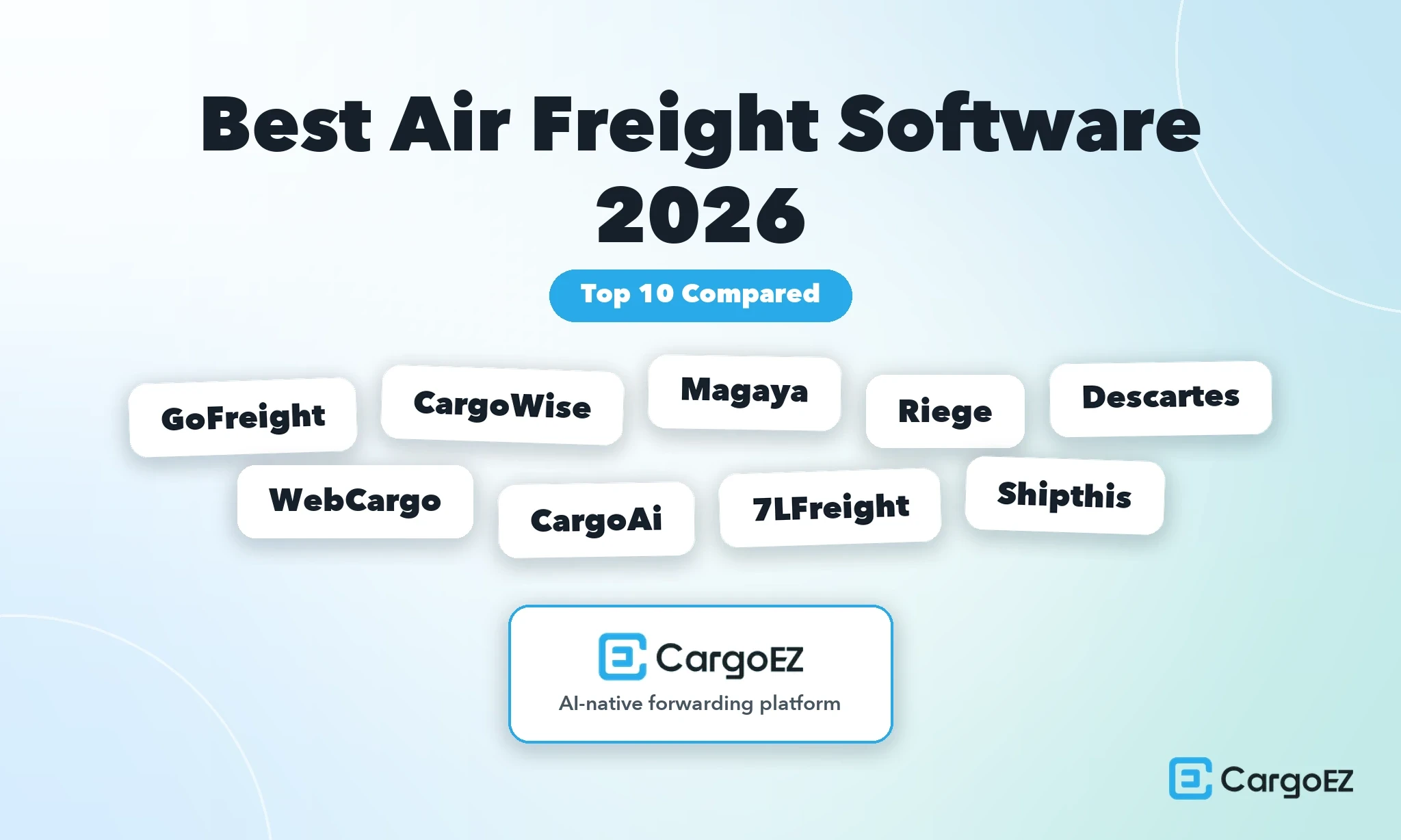
Comparing the top 10 best air freight software includes 1. CargoEZ, 2. GoFreight, 3. CargoWise, 4. Magaya Supply Chain, 5. Riege Scope, 6. Descartes, 7. WebCargo by Freightos, 8. CargoAi, 9. 7LFreight and 10. Shipthis.
Air Freight Software at a Glance
Platform | Best for | Starting price | Free trial | Implementation | Rating |
CargoEZ | US SMB forwarders running air and ocean in one system | Custom quote | Demo only | Under one month (G2 average) | |
GoFreight | SMB and midsize forwarders prioritising usability | Custom quote | Demo only | 4 to 8 weeks (vendor); about 2 months (G2 average) | |
CargoWise | Large multinational and multi-entity air operations | Per-transaction Value Pack rates | Demo, partner-led | Partner-led, scope-dependent | |
Magaya Supply Chain | Mid-market forwarders with significant handling scope | Custom quote | Demo only | 30 to 90 days (vendor guidance) | |
Riege Scope | Air-first forwarders wanting direct e-AWB and carbon reporting | Not publicly disclosed | Not publicly disclosed | Not publicly disclosed | No public rating located |
Descartes | Compliance-heavy operations needing air messaging infrastructure | Custom quote | Demo only | About 2 months (G2 average) | |
WebCargo by Freightos | Instant airline rate access and digital booking | Not publicly disclosed | Not publicly disclosed | Not publicly disclosed | No public rating located |
CargoAi | Air booking, live rates and CO2 reporting | Not publicly disclosed | Not publicly disclosed | Not publicly disclosed | No public rating located |
7LFreight | North American air and inland quoting and booking | Not publicly disclosed | Not publicly disclosed | Not publicly disclosed | No public rating located |
Shipthis | Forwarders wanting a priced, trial-ready platform | $89 per user/month | 30 days, no card | About 8 to 9 weeks (vendor) |
Two of the ten publish a number. Eight want a call first. That split predicts your sales cycle better than any feature list on this page.
Capability matrix
These five columns each disqualify somebody. A platform that cannot raise an e-AWB or file to CBP on the air side is not an air freight system, whatever else it does well.
Platform | e-AWB generation | Air customs filing | Airline rate access | Air milestone tracking | Product shape |
CargoEZ | Yes | Yes | Yes | Yes | Full forwarding platform |
GoFreight | Yes | Yes | Yes | Yes | Full forwarding platform |
CargoWise | Yes | Yes | Yes | Yes | Full forwarding platform |
Magaya Supply Chain | Yes | Yes | Not documented | Yes | Full forwarding platform |
Riege Scope | Yes | Yes | Not documented | Yes | Full forwarding platform |
Descartes | Yes | Yes | Not documented | Yes | Modular portfolio |
WebCargo by Freightos | Not documented | Not documented | Yes | Partial | Rate and booking layer |
CargoAi | Not documented | Not documented | Yes | Partial | Rate and booking layer |
7LFreight | Not documented | Not documented | Yes | Partial | Rate and booking layer |
Shipthis | Yes | Yes | Not documented | Yes | Full forwarding platform |
Not documented means we could not substantiate it publicly. Take every one of those cells into the demo as a question. None of them is a confirmed no.
What Air Freight Software Actually Fixes
Cargo moves in hours. The paperwork behind it moves at the speed of whoever is typing. That mismatch is where the money goes, and it shows up in three places.
Quoting is too slow to catch spot business. A rate request lands at 09:14. Somebody opens three carrier tariffs, calls a GSA about space on the afternoon rotation out of ORD, works the fuel and security lines by hand, and sends the quote back at 11:40. The space went at 10:05. On air, quoting speed is not admin. It is whether you win the freight.
The same numbers get typed five times. Pieces, gross weight, dimensions, shipper, consignee, commodity. Into a spreadsheet. Into the master air waybill. Into each house. Into the commercial invoice. Into the customs entry. Every retype is a chance to transpose a digit, and the ones you catch at your desk are the cheap ones. The expensive ones surface at the airline's counter. We covered the arithmetic of this in how data duplication drains freight forwarding margins.
Tracking goes dark at the airport door. Ocean gives you a sailing and an arrival, and for ocean that is mostly enough. Air needs the events in between, because that is where things go wrong. Cargo tendered but not uplifted. A consignment rolled to the next rotation because a heavier shipment paid more. A hold at customs. A handler who has not broken down the ULD yet. Without alerts on those, you learn about the problem when your customer phones you.
What good software does about it is unglamorous. One shipment record that feeds every document downstream. Live carrier rates pulled into the quote instead of copied off a PDF. Status messages from carriers and handlers landing as alerts rather than sitting in a mailbox nobody reads.
Airline Cargo Systems vs Forwarder Air Freight Software
Read this before you shortlist anything, because it will save you a fortnight.
Airline and handler systems sell capacity. Schedules, allotments, revenue management, build-up on the ramp, the carrier end of cargo messaging. IBS Software iCargo, CHAMP Cargosystems, Accelya, SITA Cargo, Kale UPLIFT, TFLite. Excellent products. Built for airlines, GSAs and terminal operators.
Forwarder platforms sell a forwarding business. Quoting against carrier rates, consol planning, masters and houses, air customs, per-shipment costing, and whatever your customer sees.
Both call themselves air cargo software. That is why a search for the phrase returns a mess, and why the AI-written listicles rank SITA next to Magaya as though a forwarder might reasonably choose between them. You would not. The revenue model is different, the user is different, and the demo will not survive contact with your first real shipment.
Everything ranked below is a forwarder platform or a forwarder-facing rate layer.
My Picks: Best Air Freight Software
CargoEZ for US small and midsize forwarders running air and ocean on one system.
GoFreight for teams who need people to actually use the thing.
CargoWise for multinationals where customs across many countries is the hard part.
Magaya Supply Chain for mid-market forwarders with processes they will not change.
Riege Scope for air-first operations that care about e-AWB and carbon.
Descartes when compliance and messaging are the problem, not admin.
WebCargo by Freightos for instant carrier rates and booking.
CargoAi for booking with CO2 reporting and API access.
7LFreight for North American desks quoting air and inland together.
Shipthis for anyone who wants a price on a web page and a trial.
How I Evaluated These 10 Platforms
Same six checks, same order, every platform. Capability claims come from vendor documentation and demos. Ratings come from G2 or Capterra, checked in August 2026, and are labelled with their sample size because a 4.8 from 13 people is a different statement from a 4.4 from 309.
Implementation figures say where they came from. A vendor estimate and a user-reported average are not the same claim and this article does not blend them. Where something is not public, it says so.
The Air Cargo Readiness Test
Gate 1. Does it build the air documents? One shipment record should produce the master, the houses under it, and an electronic air waybill that goes to the carrier. If the answer involves exporting a PDF and rekeying it into a carrier portal, that is not a pass. Our piece on electronic versus paper air waybills covers why this one matters more than it sounds.
Gate 2. Can the rate engine think in air? Chargeable against actual weight, volumetric tiers, fuel and security surcharges, contract rates and spot in the same quote. Rate tables designed for ocean contracts usually need a workaround here, and the workaround is where your margin quietly goes.
Gate 3. Air customs, specifically. ACAS data before departure, air manifest, the security requirements that apply to air and not to ocean. US operations should confirm AMS filing on the air side rather than assuming ocean coverage carries over. It often does not.
Gate 4. Real air milestones. Flight status, airport handling events, ULD movement. Some platforms map air onto an ocean milestone model and hope you do not notice. Our guide to air cargo tracking sets out what a full set looks like.
Gate 5. What it connects to. Carrier networks, cargo messaging hubs, customs, and your accounting system.
Gate 6. Can you find out what it costs, and when does it start earning? Both halves matter. A cheap platform that takes six months to go live is not cheap.
Detailed Comparison: The 10 Best Air Freight Software Platforms
1. CargoEZ
Best for
US small and midsize forwarders running air and ocean in one system.
Snapshot | Detail |
Starting price | Custom quote |
Free trial | Demo only |
Implementation | Under one month (G2 average) |
Rating |
CargoEZ is aimed squarely at the US forwarder who runs air and ocean off the same desk and is tired of reconciling two systems every month end. The air freight platform keeps one record from quote to delivery. Enter the weights, dimensions and parties once and they populate the master, the houses, the commercial invoice and the customs entry.
Its AI document capture reads inbound paperwork and pulls the shipment data out without anybody keying it. That is where an air desk loses its afternoons. ISF and AMS filing sit inside the platform rather than in a separate broker portal you tab across to.
Pros
One record drives every air document, so the AWB, invoice and filing cannot drift apart
AI document capture pulls shipment data off inbound paperwork automatically
Air and ocean share one rate, customs and finance layer
Under a month to go live on G2 averages, the quickest here
Customer portal and CRM come with it rather than as line items
Cons
No public price, so you cannot budget without talking to somebody
Demo only, no trial
Deeper door-to-door and carrier spot-rate automation are V2.0 rather than shipped today
Forty reviews is a smaller sample than the old guard carry
What users are saying
CargoEZ holds a 4.8/5 G2 rating from 40 reviews, tied for the highest score in this comparison. Ease of use, migration support and responsiveness come up repeatedly. Forty is a respectable sample for a platform at this stage and a small one next to Magaya, so read the reviews as corroboration and then put your own air workflows through a demo.
Our Verdict
Take CargoEZ seriously if you run both modes in the US and your problem is administrative rather than architectural. Too much rekeying, too many systems, a month end that eats three days. The sub-month implementation is the strongest thing on its sheet. Two things to pin down in the demo: whether your exact air filings are covered end to end, and how it behaves on carrier spot rates on your busiest lanes. Get the pricing structure in writing before you compare it to anything.
2. GoFreight
Best for
SMB and midsize forwarders prioritising usability and fast onboarding.
Snapshot | Detail |
Starting price | Custom quote |
Free trial | Demo only |
Implementation | 4 to 8 weeks (vendor); about 2 months (G2 average) |
Rating |
The most common way a software purchase fails is not that the software cannot do the job. It is that nobody in operations wants to open it. GoFreight is built against that failure, and it is the reason it keeps winning usability awards it did not have to pay for.
Underneath the interface it is a full cloud forwarding platform covering air and ocean. On air that means masters and houses, e-AWB submission, air customs and per-shipment accounting. A ten-person desk with no IT function can run it, which is the whole argument.
Pros
Usability is the single most-cited strength across 92 reviews
Complete air chain from quote through e-AWB to shipment-level margin
Carrier and accounting connectivity runs deeper than most platforms this size
Cons
No public price and no trial
Reviewers mention slowness at volume often enough to be worth testing
Requests for deeper admin controls recur in the feedback
The vendor says four to eight weeks, users average nearer two months
What users are saying
A 4.8/5 G2 rating from 92 reviews, tied with CargoEZ for the top score here and on more than double the sample. Interface, automated tracking and support draw the praise. Speed and admin depth draw the complaints. That is a healthy pattern, because both criticisms are specific enough that you can test them in an afternoon.
Our Verdict
If adoption is your binding constraint, this is the one. It is also the closest thing to a direct alternative to CargoEZ on this list, and the honest way to choose between them is to put the same three shipments through both. Push on the two documented weak spots while you do: load it up to a realistic daily volume and see how it feels, and confirm the admin controls you need exist rather than sitting on a roadmap.
3. CargoWise
Best for
Large multinational and multi-entity air operations.
Snapshot | Detail |
Starting price | Per-transaction Value Pack rates |
Free trial | Demo, partner-led |
Implementation | Partner-led, scope-dependent |
Rating |
Nobody buys CargoWise because it is pleasant. They buy it because it clears customs in thirty countries, closes books across a dozen entities and currencies, and has a module for whatever strange thing your Tokyo office does. On air that includes consolidation scenarios most platforms will not attempt.
Pricing changed on 1 December 2025. WiseTech moved to Value Packs, charging one automation fee per transaction in place of separate seat, hosting and module charges. Figures reported by GoFreight, a direct competitor, put a full import container with an inland leg at roughly $19.95 and a standalone import customs entry at roughly $9.95, with unlimited users and access to 216 modules and counting. There is still no public price list, so treat those as indicative and make your account manager put a projection in writing.
Pros
Deepest multi-country customs and compliance coverage on this list, by a distance
Unlimited users under Value Packs, which changes the arithmetic for big teams
Module breadth covers essentially any air scenario you can describe
Mature partner network to lean on during rollout
Cons
Complexity, training load and configuration depth dominate the negative reviews
No public price list, so cost discovery is a sales exercise
Rollout runs to months and depends entirely on countries, entities and modules
The 2025 pricing change was reported to raise costs for a slice of the existing base
What users are saying
4.3/5 on G2 from 35 reviews. Reviewers rate the integration breadth, the global reach and the ability to run a complicated business from one place. The same reviewers are blunt about complexity, training burden, cost and how much configuration stands between signature and value.
Our Verdict
Right answer for a multinational where the compliance surface genuinely is the business. Wrong answer for a single-country air desk, where you will pay in configuration for capability you never use. Before you compare it to anything per-user, model the transaction fees against your real annual air volume. The two pricing shapes cross over, and where they cross depends entirely on how much you ship.
4. Magaya Supply Chain
Best for
Mid-market forwarders with significant handling scope.
Snapshot | Detail |
Starting price | Custom quote |
Free trial | Demo only |
Implementation | 30 to 90 days (vendor guidance) |
Rating |
Three hundred and nine reviews. That is more than triple anything else here, and it is the main reason Magaya deserves a slot even if the score sits a little below the leaders. You are not guessing what you are buying.
What you are buying is configurability. Rate management, air document production and process automation are all there, but the thing forwarders actually choose it for is that it bends to how they already work instead of demanding they work its way. It also reaches further into handling operations than most forwarding platforms bother to.
Pros
By far the largest evidence base on this list at 309 reviews
Workflow customisation deep enough to fit established internal processes
Operational scope extends past core forwarding
Vendor gives a straight answer on timing at 30 to 90 days
Cons
No public starting price
Speed, support responsiveness and complexity recur in the negative feedback
Carrier rate connectivity is not documented to the depth the rate specialists offer
Module boundaries are where quotes move, so get them itemised early
What users are saying
4.4/5 from 309 reviews on G2. Breadth and configurability are what people like. Performance, support response times and complexity in bigger deployments are what they do not.
Our Verdict
Choose Magaya when your processes are settled and you want the system to adapt to them rather than the reverse. The sample size alone gives you more to go on than any other vendor here can offer. Get the module list and the price of each one in writing before you get attached, because scope is where these quotes grow.
5. Riege Scope
Best for
Air-first forwarders wanting direct e-AWB and carbon reporting.
Snapshot | Detail |
Starting price | Not publicly disclosed |
Free trial | Not publicly disclosed |
Implementation | Not publicly disclosed |
Rating | No public rating located |
Of everything on this list, Scope is the product that most obviously had air in mind from the start. It outranks every competitor organically for air freight software, which is less a marketing achievement than a reflection of how narrowly the product is aimed.
Two features stand out. It creates e-AWBs and transmits them to carriers directly, and it has a carbon footprint calculator built in rather than promised. That second one has moved from nice-to-have to tender requirement faster than most forwarders expected. Riege is strongest in Central Europe with reach into around 60 countries.
Pricing is per user or per module on subscription and is not published anywhere. No G2 or Capterra profile with a usable sample could be verified. One aggregator lists a single review, which is not a rating and is not reported as one here.
Our Verdict
Shortlist Scope if air is most of your business and e-AWB and carbon reporting are decision criteria rather than boxes to tick. Accept that you will learn nothing about price without a sales call.
6. Descartes
Best for
Compliance-heavy operations needing air messaging infrastructure.
Snapshot | Detail |
Starting price | Custom quote |
Free trial | Demo only |
Implementation | About 2 months (G2 average) |
Rating |
Descartes is less an application than a set of pipes. A large share of air cargo EDI already moves across its networks, which means several other platforms on this list connect to carriers and authorities through infrastructure Descartes owns. Buying it puts you on the network rather than beside it.
For air the pieces that matter are the messaging gateway and the customs and denied-party screening tools. If your constraint is regulatory rather than operational, this is built for exactly that constraint. It is also a portfolio rather than a product, which has consequences at contract time.
Pros
Owns messaging infrastructure that competitors connect through
Serious depth on customs and denied-party screening
Long-established coverage across regulatory regimes
Eighty-one reviews is a solid evidence base
Cons
Portfolio structure means product boundaries and network fees need nailing down in writing
Interface complexity, required fields and glitches come up repeatedly
No public starting price
Around two months to live on user-reported averages
What users are saying
4.3/5 from 81 reviews. Centralised shipment control, tracking and domain coverage earn the praise. Interface complexity and required-field burden earn the complaints, which makes workflow design and user acceptance testing worth real time before you roll it out widely.
Our Verdict
Buy Descartes when compliance and messaging are the hard part and you want infrastructure rather than an app. Because it is a portfolio, get the exact product list, the module boundaries and any per-message network fees in writing before you compare the total to a single-platform quote. Forwarders whose pain is administrative rather than regulatory will want a different fit.
7. WebCargo by Freightos
Best for
Instant airline rate access and digital booking.
Snapshot | Detail |
Starting price | Not publicly disclosed |
Free trial | Not publicly disclosed |
Implementation | Not publicly disclosed |
Rating | No public rating located |
WebCargo is the biggest digital air booking network there is, with live rates and instant booking across most of the carriers you already fly. If your quoting bottleneck is rate lookup, it deletes that step.
Now the correction that most comparison articles get wrong. WebCargo is a rate and booking layer. It is not a forwarding management system and it will not replace one. It sits alongside your operating platform and feeds it. Judge it as a component, not as a candidate.
One more caution, because it is an easy mistake to make. Search results will hand you a Freightos rating with a few hundred reviews behind it. That belongs to the Freightos marketplace, a shipper-facing product. It is not WebCargo's score and should never be quoted as such. No product-specific public rating for WebCargo could be verified.
Our Verdict
Add WebCargo next to your forwarding platform if rate lookup and booking speed are the bottleneck. Do not put it on a shortlist against systems that run your whole desk.
8. CargoAi
Best for
Air booking with live rates and CO2 reporting.
Snapshot | Detail |
Starting price | Not publicly disclosed |
Free trial | Not publicly disclosed |
Implementation | Not publicly disclosed |
Rating | No public rating located |
Same category as WebCargo: live carrier rates, digital booking, no forwarding platform underneath. Two things separate it. CO2 tracking sits closer to the centre of the product than it does for most competitors, and there is an API if you would rather have the rate layer inside your own system than in another browser tab.
The AI in the name is branding, not a claim being assessed here.
There is a pricing page. It carries no numbers. No public rating with a usable sample could be verified either.
Our Verdict
Worth a look where carbon reporting is a live customer requirement and you want rates reachable by API. Expect a sales conversation before you learn what it costs.
9. 7LFreight
Best for
North American forwarders quoting air and inland together.
Snapshot | Detail |
Starting price | Not publicly disclosed |
Free trial | Not publicly disclosed |
Implementation | Not publicly disclosed |
Rating | No public rating located |
A Freightos company, pointed at North America, and the only tool here that treats the air leg and the inland leg as one quote. If your business is airport-to-door out of ORD, JFK or LAX, that is a real workflow advantage rather than a feature-list item.
The vendor claims north of six million lines of air rates and more than ten thousand users. Both are vendor-stated and neither is independently verified. Contracts run month to month or annually with modules picked to suit, so cost scales with what you commit to.
No published pricing. No public rating with a usable sample.
Our Verdict
Look at 7LFreight if you are quoting air and inland together in North America and want one workflow for both. Ask for module-level pricing against your real monthly quote count, not a headline figure.
10. Shipthis
Best for
Forwarders who want a published price and a real trial.
Snapshot | Detail |
Starting price | $89 per user/month |
Free trial | 30 days, no card |
Implementation | About 8 to 9 weeks (vendor) |
Rating |
Eighty-nine dollars a user, thirty days, no card. In a category where eight of ten vendors will not tell you anything without a discovery call, that is the whole pitch and it is a good one. You can find out whether this works for you before anybody tries to sell you anything.
Feature-wise it covers the core air chain, documents and customs included, with the breadth you would expect at that price rather than enterprise depth. Nobody is claiming otherwise.
Pros
One of only two published prices on this list
Longest trial here at 30 days, and it does not ask for a card
Core air documents and customs are covered
You can budget for it before you talk to sales
Cons
Thirteen reviews, and some were vendor-referred or incentivised
Eight to nine weeks is slower than platforms with more under the hood
Not built for enterprise multi-entity requirements
Carrier rate connectivity is undocumented
What users are saying
4.8/5 on Capterra from 13 reviews, praising usability, support and the implementation experience. Thirteen is a small sample and some of it is incentivised, so treat the number as directional and let the trial do the real work.
Our Verdict
Pick Shipthis if proving the thing on your own freight matters more than enterprise depth. Then use the trial properly. Run real quotes, build a real master with houses under it, file a real entry. Thirty days of that tells you more than every rating on this page put together, ours included.
How to Choose Air Freight Software
Five tests. Run them in your demo, in this order. Each one is built to catch a platform that looks air-capable on paper.
1. One entry, full document set. Key a shipment once with dimensions and gross weight. Ask for the master, two houses under it, the commercial invoice and the customs entry, with no retyping. Listen for the moment somebody says "and then you'd export that and upload it." That sentence is the answer. Our MAWB and HAWB guide covers what a complete set contains.
2. Send an e-AWB to a real carrier. Producing the document is not the same as transmitting it. Ask to watch the message go out and the acknowledgement come back. Our notes on e-AWB implementation cover what usually breaks.
3. Move a surcharge, then requote. Change the fuel line on a lane and requote a shipment that is already priced. An air-native engine handles it without blinking. An ocean rate table usually wants the quote rebuilt from scratch.
4. Try to break chargeable weight. Give it something light and bulky where volumetric wins, then something dense where it does not. The platform should pick the right basis on its own and carry it through to pricing and the air waybill. Plenty do not.
5. Roll a flight. Ask what happens when a consignment is offloaded or held. You are looking for an alert that finds the right person, not a status that changes on a dashboard nobody has open. Our guide to real-time cargo tracking technologies covers what those feeds should carry.
For procurement questions that apply across all modes, see our list of questions to ask before buying freight forwarding software.
Air Freight Software Mistakes That Cost Money
Assuming air came in the box. Multi-modal platforms lead with ocean because that is where the volume is, and air is often thinner underneath. Run the six gates rather than reading the mode list on the pricing page.
Mistaking a rate layer for an operating system. WebCargo, CargoAi and 7LFreight are good at what they do. None of them runs a forwarding business. Buy one expecting the other and you find out halfway through implementation that you still need the other one.
Shortlisting airline systems. iCargo, CHAMP, Accelya and SITA Cargo are strong products for airlines and handlers. A forwarder who puts them on a shortlist loses a fortnight discovering the mismatch.
Comparing per-user to per-transaction without doing the sums. CargoWise charges per transaction, Shipthis per seat. Which is cheaper flips depending on your annual air volume. Model both against your real numbers before you decide anything.
Reading the score without the sample. A 4.8 from 13 people and a 4.4 from 309 are not comparable claims, and the AI-generated listicles that rank these tools will never tell you that.
Skipping the air filing test. ISF and air security filings carry real penalties for late or wrong submissions. Confirm the platform files what you are obliged to file, on the air side, before anybody signs.
Which Air Freight Platform Fits Your Operation?
Air and ocean, under 50 staff, US. CargoEZ or GoFreight. Run the same three shipments through both and decide on implementation speed and how your team feels about the interface.
You want proof before budget. Shipthis. It is the only genuine try-before-you-buy here.
Air is most of what you do. Riege Scope, for the air-first design, direct e-AWB and carbon reporting.
Multinational, customs everywhere. CargoWise. Model the transaction cost first.
Your processes are fixed. Magaya, for configurability and the biggest evidence base on the page.
Compliance and messaging are the problem. Descartes.
Rate lookup is the bottleneck, not operations. WebCargo or CargoAi beside your existing platform, or 7LFreight if you quote air and inland together in North America.
The Bottom Line on Air Freight Software
This is a smaller category than the search results make it look. Take out the airline and handler systems. Take out the rate layers that are not operating platforms. What remains, the products that can genuinely run a forwarder's air desk end to end, is a short list.
Two questions sort it. Does the platform build and transmit air documents from one record, or does it hand you a PDF to retype somewhere else? And can you find out what it costs? Only two of the ten answer that second one on a web page, which tells you more about the months ahead than any feature grid will.
Judge on time to live, admin overhead and whether the price is knowable before a sales cycle. Then run the five tests on your own freight. A platform that passes all five on real shipments beats every rating on this page, ours included.
Comparing across modes rather than air alone? Our best freight forwarding software comparison covers the same vendors on wider criteria, and freight rate management software goes deeper on pricing engines.
Sources
CargoEZ on G2, checked August 2026
GoFreight on G2, checked August 2026
CargoWise on G2, checked August 2026
Magaya Supply Chain on G2, checked August 2026
Descartes Forwarder Enterprise Suite on G2, checked August 2026
Shipthis on Capterra, checked August 2026
Riege Scope air freight, vendor documentation
WebCargo by Freightos, vendor documentation
CargoAi, vendor documentation
7LFreight by Freightos, vendor documentation
CargoWise Value Pack transaction rates as reported by GoFreight, December 2025 pricing change
1. What is air freight software?
It is the system a freight forwarder runs their air cargo business on: quoting against carrier rates, consol planning, masters and houses, e-AWB transmission, air customs, milestone tracking and per-shipment costing. It is a different product from an airline cargo system, which manages capacity and revenue on the carrier side.
2. What is the difference between air freight software and air cargo software?
In marketing, nothing. In practice, air cargo software more often means airline and handler systems, while air freight software more often means forwarder platforms. Work out which side of the market a product serves before it reaches your shortlist.
3. How much does air freight software cost?
Two of the ten here publish anything. Shipthis lists $89 per user per month. CargoWise publishes per-transaction Value Pack rates, reported at around $19.95 for a full import container with an inland leg. The other eight quote custom. Category ranges get cited anywhere from a few thousand a year for a small team to six figures for a large multinational rollout, but those are observed market ranges rather than vendor-confirmed figures.
4. What is an e-AWB and which platforms generate one?
An electronic air waybill replaces the paper contract of carriage between forwarder and airline. CargoEZ, GoFreight, CargoWise, Magaya, Riege Scope, Descartes and Shipthis all produce air waybills, though transmission is worth confirming carrier by carrier in your demo. Our e-AWB guide covers the mechanics, and there is dedicated e-AWB software where that is the only gap you have.
5. Does air freight software handle ACAS and air security filing?
Full platforms generally do. Rate and booking layers generally do not. Confirm the specific filings you are obliged to submit rather than accepting "customs filing" as a feature, because ocean coverage does not imply air coverage.
6. Can air freight software track ULD movements?
Some include unit load device tracking alongside flight status and airport handling events. It is one of the sharpest tests of whether a platform is air-native or is quietly mapping air onto an ocean milestone model.
7. What is the best air freight software for a small forwarder?
For a US desk running air and ocean, CargoEZ and GoFreight are the closest fits and both sit at 4.8 on G2. Add Shipthis if you want to test on a 30-day trial before committing anything.
8. How long does it take to get an air desk running on new software?
Anywhere from under a month to several, tracking platform size. CargoEZ averages under a month on G2 data. GoFreight quotes four to eight weeks. Shipthis says eight to nine. Magaya guides to 30 to 90 days. Descartes averages around two months. CargoWise is partner-led and depends entirely on countries, entities and modules.
9. Should we build instead of buying?
Building means owning the regulatory maintenance forever, and air carries ACAS, security filing and IATA messaging requirements that keep changing. For most forwarders that burden outweighs the fit you gain. It becomes defensible only when your operating model is genuinely unlike the rest of the market.
10. Do these platforms use AI?
CargoEZ uses AI document capture to pull shipment data off inbound paperwork without manual keying. For a full comparison of AI capability across forwarding platforms, see our best AI freight forwarding software article.
11. Can one platform handle both air and ocean?
Yes, and for most forwarders it is the right call, because it removes the month-end reconciliation between two systems. What to verify is that air is properly built out rather than layered on an ocean core. The five tests above exist to expose that difference.
12. Why do so few vendors publish pricing?
Vendors argue that scope by modules, entities, filing coverage and volume makes a list price misleading. Fair enough. The consequence for you is a longer sales cycle, so ask for base subscription, per-user cost, module enablement and integration setup as four separate lines. Otherwise you cannot compare two quotes honestly.
Don't forget to share this blog!