Top 6 Features of a Logistics CRM for Freight Forwarders
Author:
Priyanka
Published On:
Updated On:
1 min read
Most freight forwarders try to run their sales pipeline in HubSpot, Zoho, Salesforce, or worse — spreadsheets and email.
Those tools weren't built for an industry where a "deal" is a quote that depends on live ocean rates, vendor estimates, and a chargeable weight calculation.
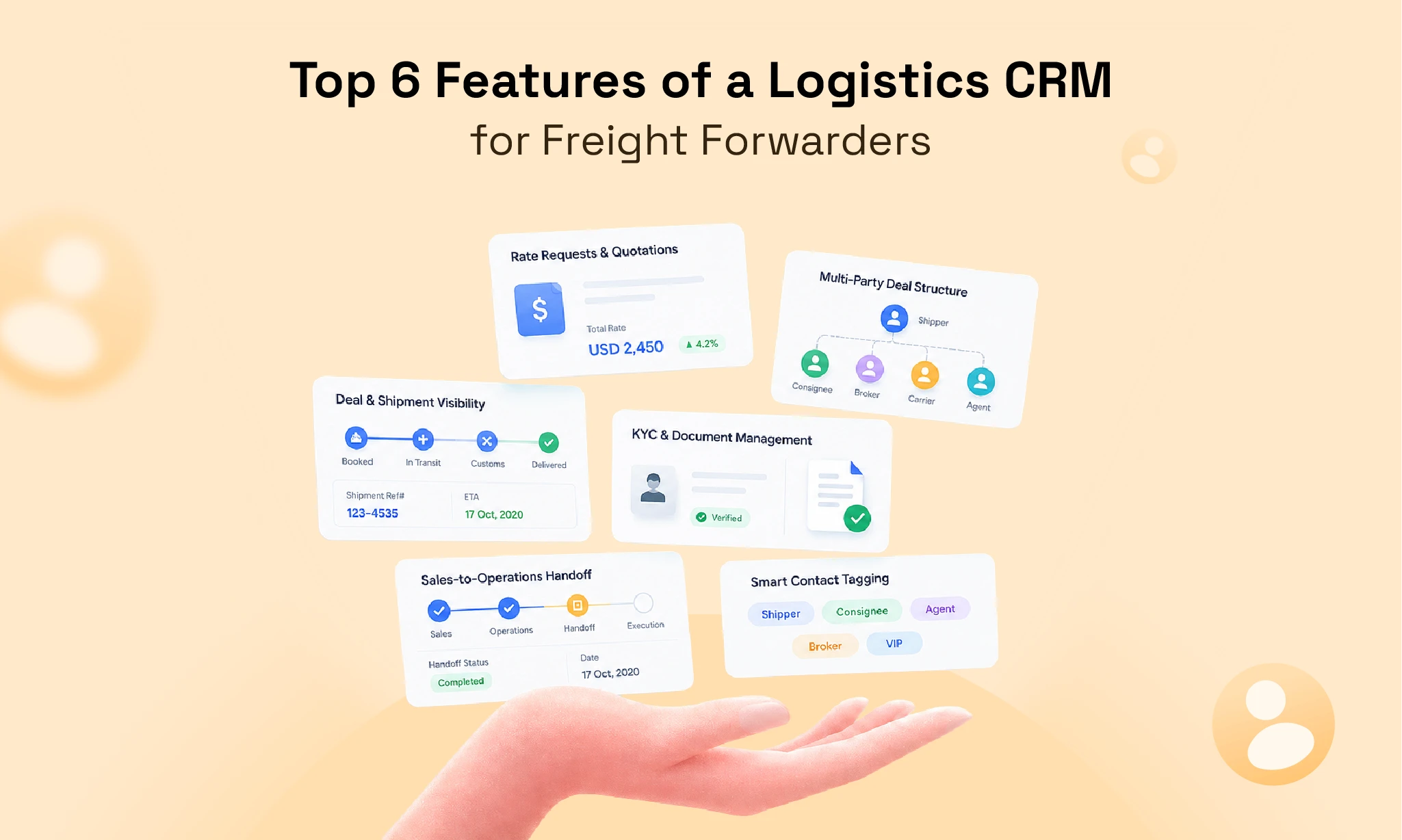
A logistics CRM for freight forwarders has to do six things a generic CRM can't — and choosing the best CRM for the logistics industry starts with knowing what those six things are.
In this blog, we'll cover what those six features are, why each one matters in day-to-day forwarding operations, and what to look for when evaluating a CRM built for the way your business actually works.
Why Generic CRMs Fall Short for Freight Forwarders
Generic CRMs like HubSpot, Zoho, and Salesforce are built for a simple sales model — a contact, a deal, a price, and a close date. That works for software or consulting. It does not work for freight forwarding.
A forwarder's deal is not a single number. It is a rate request to multiple carriers, a stack of vendor estimates, and a quotation with terms tied to the lane, mode, and commodity.
Generic CRMs cannot handle this. They also stop being useful the moment the deal is won — when the real work of booking, customs, and invoicing begins — because they do not connect to the operations system.
On top of this, generic CRMs have no way to handle compliance tasks like KYC, Power of Attorney, or denied party screening, which are required for every US and Canadian forwarder.
The features a freight forwarder primarily needs in a CRM follow below.
1. Rate Request, Vendor Estimate, and Customer Quotation in One Workflow
A logistics CRM for freight forwarders has to handle the full quoting workflow, not just a single price field. In freight, a quote is not just a number — it is a process.
The salesperson sends rate requests to multiple carriers and overseas agents. Each one replies with different costs, transit times, and validity periods.
The salesperson then compares the options, adds a markup, and sends the customer a quotation with the right terms, often before the original rate expires.
The CRM must handle this entire process in one place. It should also turn rate requests that arrive by email into structured leads automatically, so no inquiry gets missed in a shared inbox.
2. Multi-Party Deal Structure
A freight management CRM has to handle more than one party per deal. A forwarding shipment is never between just two parties.
A single deal can involve a shipper at origin, a consignee at destination, a notify party such as a customs broker, and an overseas agent handling the other end.
Each party has its own contact details, role, and documents.
Generic CRMs only know how to handle one customer per deal. Everyone else gets typed into a notes field or a spare text box.
The CRM must let you add every party to a lead or shipment as a proper record — with its own role, address, and history — so the full structure of the deal is visible to anyone who opens it.
3. End-to-End Deal and Shipment Visibility
A CRM designed for freight forwarders has to give the sales manager a clear view of every deal.
A forwarding sales team can have dozens of deals in progress at the same time. Each one is at a different stage — some are still at the quote stage, some are waiting for the customer's decision, some are close to booking, and some are stuck.
Without a clear view, the sales manager has no way to know which deals need attention, which are at risk, or which are about to close.
This is what a sales funnel solves. The CRM must show every deal in one place, grouped by stage, so the manager can see the full pipeline at a glance and step in where it matters.
4. Compliance, KYC, and Document Management
A freight forwarding CRM software must let you view all of this in one place at the contact level.
The KYC details, the Power of Attorney, the watchlist screening, and every shipping document tied to that customer should sit together inside the customer record.
This includes contracts, rate agreements, insurance certificates, bills of lading, commercial invoices, packing lists, and certificates of origin.
The system should also allow any number of shipping documents to be stored against a single contact, with no limits, so the full history of the relationship stays in one place.
5. Handoff to Operations, Finance, and the Customer Portal
A CRM built for freight forwarding cannot work as a standalone tool. The moment a quote is won, the work moves to operations, finance, and the customer.
If the CRM is separate from these systems, the salesperson loses visibility, the operations team loses the context of what was promised, and the customer has to chase updates over email.
The CRM must connect directly to the freight, finance, and customer portal modules in the same platform.
A won lead should turn into a shipment without re-entry, flow into invoicing automatically, and appear in the customer's portal — all without anyone having to copy data from one system to another.
6. Smart Tagging and Filtering for Freight Contacts
A CRM for shipping and logistics has to manage a large and varied contact list. A single forwarder works with shippers, consignees, manufacturers, shipping lines, airlines, customs brokers, trucking companies, and overseas agents — sometimes hundreds of each.
Without a way to organise these contacts, the address book quickly becomes a list nobody can navigate.
The CRM must allow each contact to be tagged by type, role, region, mode, or any other label the forwarder uses.
The team should then be able to filter the contact list using these tags, so finding "all shipping lines in the Pacific trade" or "all manufacturers in the textile category" takes seconds, not a manual search through thousands of records.
Conclusion
A freight forwarder's work is not a simple sales pipeline. It is rate requests, vendor estimates, multi-party deals, compliance checks, and a constant handoff between sales, operations, and finance.
A generic CRM was never built for any of this, which is why most forwarders end up running their sales out of inboxes and spreadsheets. A logistics CRM built for freight forwarders solves this by handling the full reality of the business in one place — from the first email inquiry to the final invoice.
Platforms like CargoEZ are designed around exactly this, with a CRM that connects directly to freight, finance, and the customer portal on the same system.
If your team is still working out of inboxes and spreadsheets, it may be time to see what a purpose-built CRM looks like.
Frequently Asked Questions (FAQs)
1. What is a logistics CRM, and how is it different from a regular CRM?
A logistics CRM is built for the way freight forwarders work — managing rate requests, vendor estimates, multi-party shipments, and compliance checks — instead of the simple "contact, deal, close" model used by tools like HubSpot or Salesforce. A regular CRM tracks sales activity. A logistics CRM tracks the full forwarding workflow, from the first inquiry to the final invoice.
2. Can I use HubSpot, Zoho, or Salesforce for my freight forwarding business?
You can, but you will run into limits quickly. These tools cannot handle rate requests to multiple carriers, vendor estimates, multi-party deals, or compliance tasks like KYC and Power of Attorney. Most forwarders who start on a generic CRM end up tracking the real work in spreadsheets and email anyway.
3. What features should I look for in a CRM for freight forwarders?
The core ones are a rate request and quotation workflow, multi-party deal handling (shipper, consignee, notify, agent), a sales pipeline view with followups and win/loss tracking, in-context chat tied to deals, compliance handling at the contact level (KYC, POA, denied party screening), and a direct connection to your freight, finance, and customer portal modules.
4. How does a logistics CRM handle compliance like KYC and denied party screening?
A purpose-built logistics CRM keeps compliance inside the customer record itself. The KYC check, the signed Power of Attorney, the denied party screening result, and supporting documents all sit at the contact level — so the same record carries the customer's identity, history, and compliance status without needing a separate tool.
5. Can a logistics CRM connect with my operations and finance systems?
A CRM built for freight forwarders should not be a standalone tool. The best platforms include the CRM, freight operations, finance, and customer portal as part of the same system — so a won lead becomes a shipment, a shipment becomes an invoice, and the customer sees it all in their portal without anyone re-entering data.
6. How long does it take to set up a logistics CRM for a freight forwarding business?
It depends on the platform. Heavy enterprise systems can take six months or more to implement. Modern logistics CRMs designed for small and mid-sized forwarders typically live in a few weeks, with data migration, user setup, and training included.
7. Is a logistics CRM worth it for a small and medium freight forwarder?
Yes — often more than for a large one. Small forwarders feel the pain of lost rate requests, missed followups, and scattered customer data the most, because they have fewer people to absorb the gaps. A logistics CRM gives a small team the same operational discipline a much larger competitor has.
Don't forget to share this blog!