Best FreightSuite Alternatives in 2026 (Top 8 Compared)
Author:
Pamela
Published On:
1 min read
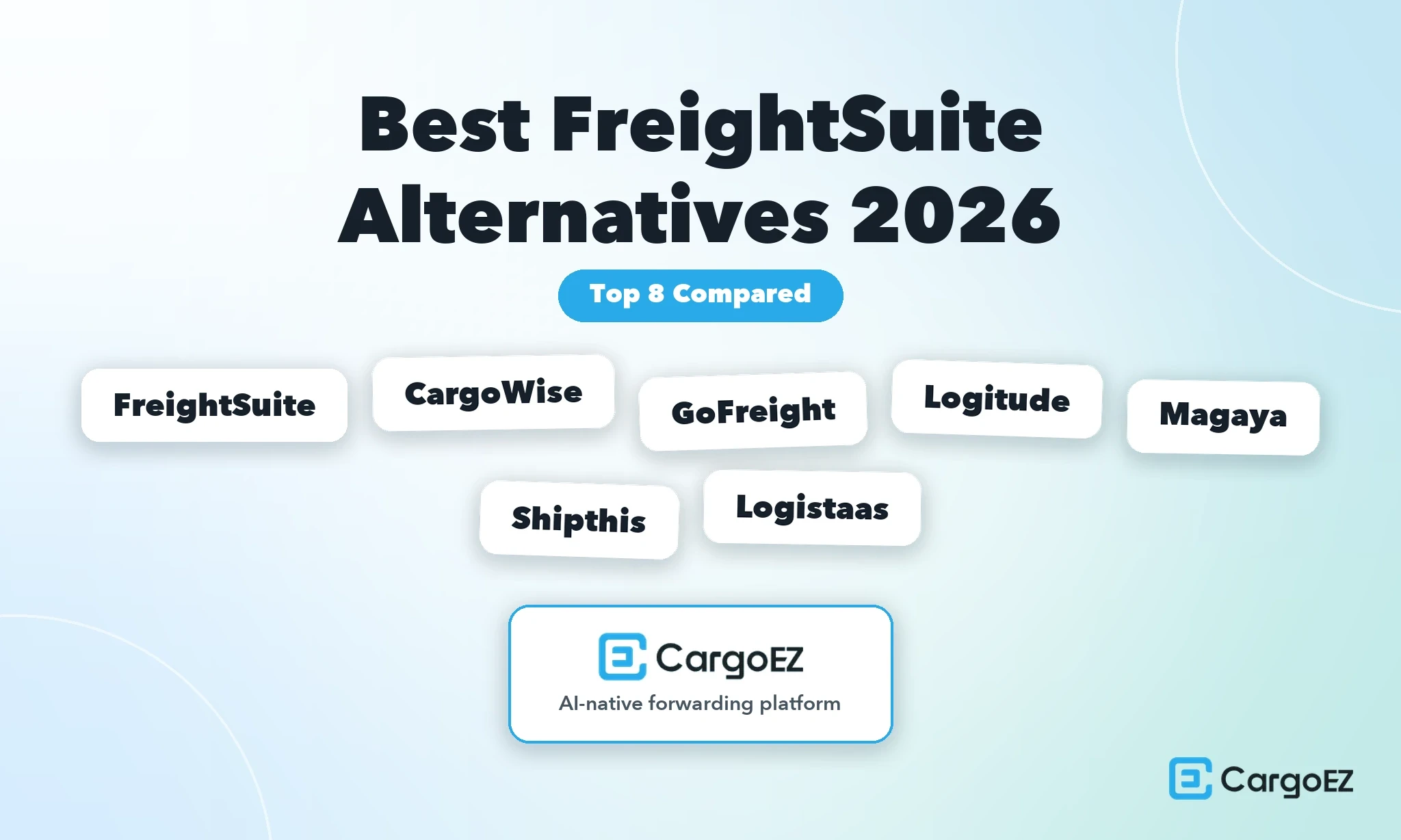
Comparing the top 8 best FreightSuite alternatives includes 1. CargoEZ, 2. FreightSuite, 3. CargoWise, 4. GoFreight, 5. Logitude World, 6. Magaya, 7. Shipthis and 8. Logistaas.
Most forwarders do not go shopping for software because they want software. They go shopping because a specific thing broke.
The thing that usually broke is the handoff. A quote goes out from a spreadsheet, the booking gets typed into an operations system, the arrival notice gets typed again into a customs filing tool, and the invoice gets typed a fourth time into the accounting package. Four systems, four versions of the same shipment, and no single record that says what this job actually earned. By the time the month closes, the margin number is a reconstruction rather than a fact.
FreightSuite Alternatives at a Glance
Platform | Best for | Starting price | Free trial | Implementation | Rating |
CargoEZ | US small and midsize air and ocean forwarders | Custom quote, no public price | Not documented | Under one month (G2 average) | G2 4.8/5 (40 reviews) |
FreightSuite | Scaling mid-sized and enterprise forwarders | Not publicly disclosed, quote only | Not documented | Not documented | No public reviews |
CargoWise | Large multi-country forwarding networks | No public dollar figures, per-job transaction fee (Value Packs, from 1 Dec 2025) | Not documented | Certified Service Partner led, G2 ease of setup 6.4/10 | G2 4.3/5 (35 reviews); Capterra 2.9/5 (32 reviews) |
GoFreight | Forwarders wanting the deepest recent US review base | Not publicly disclosed | Not documented | 4 to 8 weeks (vendor claim) | G2 4.8/5 (92 reviews); Capterra 4.6/5 (25 reviews) |
Logitude World | Teams that want published per-user pricing | $75 per user/month (Smart) | Not documented | Not documented | |
Magaya | Forwarding, customs, warehouse and accounting in one system | Not publicly disclosed | Not documented | G2 ease of setup 8.2/10, reviewers report a lengthy paid process | G2 4.4/5 (281 reviews); Capterra 4.4/5 (51 reviews) |
Shipthis | Forwarders and NVOCCs that want to trial before buying | $89 per user/month (Standard) | 30 days, no card | Not documented | |
Logistaas | Cost-sensitive small and mid forwarders | $45 per user/month, plus one-time implementation fee | Not documented | One-time implementation fee, timeline not documented | Capterra 4.5/5 (33 reviews) |
Table 2: Capability matrix
Platform | Modes | US customs filing (AMS/ISF) | Built-in accounting ledger | Public pricing | Independent review base |
CargoEZ | Air and ocean, road on the V2.0 roadmap | AMS and ISF in the Customs module (beta) | Yes, native double-entry ledger | No, custom quote | G2 4.8/5 from 40 reviews |
FreightSuite | Ocean, air, road and customs brokerage (vendor published) | Customs brokerage published, AMS/ISF specifics Not documented | Not documented | No, not publicly disclosed | None published on any major platform |
CargoWise | Forwarding, customs, land transport and warehouse (Value Pack lines) | Stand-Alone Customs Value Pack published, AMS/ISF specifics Not documented | Not documented | Model published, no dollar figures | |
GoFreight | Not documented | Not documented | Present, reviewers report functional gaps | No, not publicly disclosed | |
Logitude World | Not documented | Not documented | Present, reviewers report missing reports | Yes, three published tiers | |
Magaya | Forwarding, customs and warehouse | Customs included in the single-system scope, AMS/ISF specifics Not documented | Yes, accounting in the same system | No, not publicly disclosed | |
Shipthis | Not documented, serves forwarders and NVOCCs | Not documented, a reviewer reports customs clearance tasks cannot be automated | Yes, Freight Accounting included in Standard | Yes, $89 Standard published | |
Logistaas | Not documented | Not documented, a reviewer reports AES filing is absent | Yes, native accounting | Yes, three published tiers | Capterra 33 reviews |
"Not documented" does not mean "no." It means the capability could not be substantiated from public vendor documentation or from independent review evidence at the time of writing.
My Picks: Best FreightSuite Alternatives
CargoEZ is best for US small and midsize air and ocean forwarders that want CRM, rate desk, operations, a native ledger and US customs filing writing to one shipment record.
FreightSuite is best for scaling mid-sized and enterprise forwarders who are comfortable evaluating a well-funded new entrant on reference checks rather than on a public review base.
CargoWise is best for large multi-country networks that need enormous functional depth and can staff a certified-partner implementation.
GoFreight is best for forwarders who want the deepest current US review base on this list before they commit.
Logitude World is best for teams that want published per-user pricing and consistently strong support scores.
Magaya is best for forwarders who genuinely need forwarding, customs, warehouse and accounting in one system.
Shipthis is best for forwarders and NVOCCs that want to test a platform for 30 days before signing anything.
Logistaas is best for cost-sensitive small and mid forwarders who want native accounting with no per-shipment fees.
How I Evaluated These 8 Platforms
The framework here is The Proven-Platform Test, seven gates chosen because each one has, in real buying processes, eliminated a product that looked fine on a feature grid. The seventh gate is the one this particular comparison turns on.
Gate 1: Automated quoting and rate management
Can the platform hold contract rates, produce a quote from them, and carry the winning rate into the job without a re-key? A rate library that does not feed operations is a reference document, not a workflow. Logitude World and CargoEZ both put the rate desk in the same product as operations. Shipthis includes Tariff & Rate and Quotation in its base tier.
Gate 2: Document processing and data capture
Arrival notices, house and master bills, commercial invoices and packing lists arrive as PDFs and email attachments, and somebody currently retypes them. The gate is whether extraction writes into the shipment fields, not whether the file gets stored. Ask for a live demo on your documents, not the vendor's sample set, because extraction accuracy on a clean template tells you nothing about your carrier's formatting.
Gate 3: Customs and compliance integration
For a US-facing forwarder this means AMS and ISF inside the operational record, with filing status visible to the person handling the shipment. CargoEZ's Customs module is in beta and covers AMS and ISF. CargoWise publishes a Stand-Alone Customs Value Pack. Magaya includes customs in its single-system scope. Several others do not publicly document US filing, and one reviewer explicitly flagged its absence at Logistaas.
Gate 4: Financial and per-shipment profit tracking
Two questions, and the second one is the hard one. Does the platform have a real ledger, and can it tell you what an individual job earned after all costs landed? This is where the review evidence is loudest. GoFreight, Logitude World and Magaya all carry specific, named reviewer complaints about accounting depth or sync reliability. CargoEZ's Finance module is a native double-entry ledger sitting on the same shipment record as operations, which removes the sync question rather than answering it.
Gate 5: Customer self-service portals
Every hour your team spends answering "where is my container" by email is an hour of unbilled work. A customer portal shifts that to self-service. The gate is not whether a portal exists but whether it shows documents, milestones and invoices without your team staging anything.
Gate 6: Implementation timeline and support
A platform you cannot get live is a platform you do not have. CargoEZ's G2 reviewers report going live in under one month on average. GoFreight claims 4 to 8 weeks, and that figure is a vendor claim rather than an independently verified one. CargoWise runs implementation through certified Service Partners, and WiseTech states that "CargoWise Service Partners are logistics and IT experts who will guide you through your CargoWise implementation." Its G2 ease-of-setup score of 6.4 out of 10 is the lowest in this set.
Gate 7: Depth of independent review evidence
This is the gate that separates this comparison from a feature grid. A capability claim from a vendor and a capability confirmed by 90 buyers who have lived with the product for a year are not the same asset, and they should not carry the same weight in a decision.
Magaya has 281 G2 reviews. Logitude World has 94. GoFreight has 92. CargoEZ has 40. CargoWise has 35 on G2 and a Capterra pool that stopped in May 2022. Shipthis has 13 on Capterra and a single G2 review. FreightSuite has none published anywhere.
None of those numbers is a verdict on product quality. They are a measure of how much external verification you get for free before you sign, and therefore of how much verification work you have to do yourself. That is a real cost, and it belongs in the evaluation.
Detailed Comparison
1. CargoEZ
Best for
US small and midsize air and ocean forwarders that want sales, operations, finance and US customs filing on one shipment record.
Starting price | Custom quote, no public price |
Free trial | Not documented |
Implementation | Under one month (G2 average) |
Rating | G2 4.8/5 from 40 reviews |
Best for | US small and midsize air and ocean forwarders |
CargoEZ is built around one idea, which is that a shipment should live in a single record rather than being passed between modules. The specifics:
Nine modules on one login. Contacts, Leads, Rates, Freight, Finance, Warehouse, Chat, Customs and Admin.
One shipment record. CRM, rate desk, operations, the ledger and customs all write to the same file, so a quote becomes a booking without a re-key.
Costs post where they accrue. The costs on the job are the costs the ledger posts, and the customs filing references the file the operator already has open.
A native double-entry ledger. Finance is the book of record, not a bridge to an accounting package, so there are no two sources of truth to reconcile.
US customs in the platform. The Customs module covers AMS and ISF and is currently in beta.
Deliberately narrow. Built for US air and ocean forwarders, not NVOCCs, enterprise global forwarders, trucking-only operations, parcel or warehousing-first businesses.
V2.0 work. Road and door-to-door movements, spot-rate procurement and direct ACE portal connectivity.
Implementation. Under one month on average per G2, the fastest documented figure in this comparison.
Security. SOC 2, ISO 27001, GDPR, TLS 1.2+ in transit and AES-256 at rest.
That architecture targets the problem that dominates the review evidence in this category, which is not missing features but data a person has to move between modules or between systems.
Pros
Nine modules on one login and one shipment record, with CRM, rates, operations, ledger and customs all writing to the same job
A real native double-entry ledger rather than an export to an external accounting package
AMS and ISF filing inside the Customs module, aimed squarely at US air and ocean work
Implementation under one month on the G2 average, the fastest documented in this comparison
SOC 2, ISO 27001, GDPR, TLS 1.2 or higher and AES-256
Cons
No public pricing, so budget qualification requires a call
Road and door-to-door coverage is V2.0 rather than shipping today, which matters if you run road legs in-house. FreightSuite publishes road coverage, so this is a genuine point of difference to weigh
Direct ACE portal access is V2.0
The Customs module is in beta, and beta status is a fair thing to probe in a demo
Read the full CargoEZ review
Snapshot. A single-record freight forwarding platform for US small and midsize air and ocean forwarders, built so the CRM, rate desk, operations, ledger and customs filing all work from the same shipment.
Tool features. Contacts, Leads, Rates, Freight, Finance (native double-entry ledger), Warehouse, Chat, Customs (beta, including AMS and ISF) and Admin, all on one login.
What it costs. Custom quote with no public price. Pricing is qualified on a call, so budget-gating happens before the demo rather than after. See CargoEZ pricing.
Best fit for. US-based small and midsize forwarders moving air and ocean freight who are currently running a quoting spreadsheet, an operations system and a separate accounting package, and who want US customs filing in the same place as the job.
Not built for. NVOCC-first operations, enterprise multi-country networks, trucking-only fleets and parcel operators. All four will want a different fit.
What users are saying
CargoEZ holds 4.8/5 on G2 from 40 reviews, tied for the highest score in this comparison alongside GoFreight. The sample-size caveat is real and worth stating plainly: 40 reviews is a meaningfully smaller pool than Magaya's 281, Logitude World's 94 or GoFreight's 92, and a smaller pool is more sensitive to who happened to write. The same G2 pool is the source for the under-one-month implementation average, which is the fastest documented here.
Our Verdict on CargoEZ
CargoEZ is the strongest fit here for a US small or midsize air and ocean forwarder that is tired of maintaining four versions of the same shipment. The single-record architecture and the native ledger remove a class of failure that shows up repeatedly in other vendors' reviews, and under-a-month implementation is the fastest documented in this set. Verify two things on the demo: the beta status of the Customs module against your filing volume, and whether road being V2.0 blocks you today. Schedule a demo.
2. FreightSuite
Best for
Scaling mid-sized and enterprise forwarders who are willing to evaluate a well-funded new entrant on reference checks rather than a public review base.
Starting price | Not publicly disclosed, quote only |
Free trial | Not documented |
Implementation | Not documented |
Rating | No public reviews on G2, Capterra, Software Advice, GetApp or TrustRadius |
Best for | Mid-sized and enterprise forwarders that are scaling |
FreightSuite is a London-headquartered freight forwarding transport management platform. The specifics:
Modal coverage and vendor branding. Ocean, air, road and customs brokerage, and its founders market it as "AI-native" and "agentic," which is their branding rather than an independently assessed capability.
Backing. It raised approximately $4.5 million in a pre-Series A round led by Superseed Ventures in December 2025, and integrated Freightos air-cargo booking in July 2026.
Who it is positioned for. Mid-sized and enterprise freight forwarders that are scaling, pitched explicitly as a CargoWise alternative.
Pricing and evidence base. Pricing is not publicly disclosed and is quote only, and there is no rating or review count on any of the five major software review platforms, which is the expected position for a company at this stage rather than a mark against the product.
Our verdict on FreightSuite: A promising new entrant with credible backing, broad published modal coverage including road, and a clear enterprise-facing positioning, which deserves a place on a shortlist and a harder-than-usual diligence process. Because there is no independent review base to lean on, do the verification yourself: ask for three customer references at your size and in your trade lanes, get the data-exit terms in writing, and keep the first contract term short. That is ordinary practice for any young vendor, and it is the fair way to evaluate one.
3. CargoWise
Best for
Large multi-country forwarding networks with the internal capacity to run a certified-partner implementation.
Starting price | No public dollar figures, all-in transaction fee per logistics job (Value Packs, from 1 December 2025) |
Free trial | Not documented |
Implementation | Certified Service Partner led, G2 ease of setup 6.4/10 |
Rating | G2 4.3/5 (35 reviews); Capterra 2.9/5 (32 reviews) |
Best for | Large multi-country forwarding networks |
CargoWise is the platform FreightSuite explicitly positions against, which makes it the most important comparison on this page for anyone who arrived here from a FreightSuite pitch. The specifics:
The commercial model changed on 1 December 2025. WiseTech launched CargoWise Value Packs and states that "there are no longer any CargoWise Cloud standard hosting costs or seat fees in the CargoWise Value Packs."
Charging is now per job. WiseTech states that charges are "an all-in-one transaction fee per logistics job, such as a shipment, stand-alone customs declaration, land transport movement or warehouse order line."
Four packs, no dollar figures. Forwarding, Stand-Alone Customs, Contract Warehouse Manager and Land Transport, with no public dollar figures accompanying them.
Seat pricing and transaction pricing scale differently. Seat-based pricing scales with headcount and transaction-based pricing scales with volume, so which one is cheaper depends entirely on your shipments-per-employee ratio. A high-volume, lean team can land on the wrong side of that maths, so model it on your own numbers before you compare quotes.
The G2 pool. G2 sits at 4.3 from 35 reviews.
The Capterra pool is frozen. Capterra sits at 2.9 from 32 reviews, and that pool contains no reviews after May 2022, so it describes a product generation and a commercial model that have both since changed.
Software Advice sub-scores are the most useful diagnostic. Ease of use 2.7, value 2.6, support 1.9, functionality 3.4, and functionality is its highest score.
Capability is not the complaint. What buyers push back on is usability, cost-to-value and support responsiveness, which is a very different problem from a product that cannot do the job.
Pros
Functionality is its highest-rated dimension on Software Advice at 3.4, so breadth of capability is not in dispute
The Value Pack model removed standard hosting costs and seat fees, which changes the economics for headcount-heavy teams
Four distinct packs let a business buy only the operational line it runs
A formal certified Service Partner network exists specifically to run implementations
Cons
Software Advice support sub-score of 1.9 is the weakest signal in this comparison
Ease of use 2.7 and value 2.6 both sit low
G2 ease of setup 6.4/10 is the lowest in this set
No public dollar figures for any Value Pack, so quote comparison requires a sales process
Per-job transaction pricing can work against high-volume, small-team operations
The Capterra pool has been static since May 2022
Read the full CargoWise review
Snapshot. The incumbent enterprise forwarding platform, repriced in December 2025 onto an all-in per-job transaction model, and the product most new entrants define themselves against.
Tool features. Four Value Packs covering Forwarding, Stand-Alone Customs, Contract Warehouse Manager and Land Transport, supported by a certified Service Partner implementation network.
What it costs. From 1 December 2025, an all-in-one transaction fee per logistics job, with no CargoWise Cloud standard hosting costs and no seat fees. No public dollar figures.
Best fit for. Large multi-country networks that need the functional depth, and that have the internal project capacity to work with a certified Service Partner through go-live.
Not built for. Small forwarders wanting a fast, light implementation, or lean high-volume teams whose shipment count vastly outruns their headcount. Both will want a different fit.
What users are saying
G2 rates it 4.3/5 from 35 reviews. Capterra sits at 2.9/5 from 32 reviews, with nothing posted after May 2022, so date-stamp that figure when you use it. The Software Advice sub-scores, ease of use 2.7, value 2.6, support 1.9 and functionality 3.4, point consistently at experience and service rather than at capability. WiseTech describes its implementation model directly: "CargoWise Service Partners are logistics and IT experts who will guide you through your CargoWise implementation."
Our Verdict on CargoWise
CargoWise remains the right answer for large multi-country networks that need maximum functional depth and can resource the project properly. Its own review evidence says the capability is there and the experience around it is the weak point, particularly support at 1.9 on Software Advice. If you are a small or midsize forwarder, price the new per-job transaction model against your actual shipment volume before assuming the removal of seat fees is good news for you.
4. GoFreight
Best for
Forwarders that want the deepest current US review base on this list before committing.
Starting price | Not publicly disclosed |
Free trial | Not documented |
Implementation | 4 to 8 weeks, a GoFreight vendor claim |
Rating | G2 4.8/5 (92 reviews); Capterra 4.6/5 (25 reviews, dated 2019 to 2020) |
Best for | US forwarders wanting well-reviewed operations software |
GoFreight carries one of the strongest current review profiles in this comparison. The specifics:
A large, current G2 sample. 4.8 out of 5 from 92 G2 reviews, which is a substantial sample by this category's standards.
Capterra is not current sentiment. Its Capterra reviews are dated 2019 to 2020 and should not be read as current sentiment.
The implementation figure is a vendor claim. The vendor states an implementation timeline of 4 to 8 weeks. That is a vendor claim, not an independently verified figure, and it belongs in your evaluation as a commitment to hold them to rather than as an established fact.
Accounting is where the review evidence gets specific. It is consistent enough to be a pattern rather than a one-off. Frank F. wrote that GoFreight needs "more account function...don't need another accounting software running."
Invoice revision and reconciliation. Edward L. wrote that the "accounting function does not allow to revise and reconcile invoices with ease." Both point at the same place: the ledger is present, but reviewers want more depth from it.
Warehouse draws a similar note. Kevin C. wrote that the "warehouse function is very limited...no e-commerce supported feature."
Pros
G2 4.8/5 from 92 reviews, one of the strongest current samples here
Vendor-stated implementation of 4 to 8 weeks is competitive if it holds
Strong US forwarding operations focus
Cons
Multiple reviewers ask for deeper accounting function, with invoice revision and reconciliation named specifically
Warehouse function described by a reviewer as very limited, with no e-commerce support
No public pricing
Capterra reviews date from 2019 to 2020 and do not reflect the current product
Read the full GoFreight review
Snapshot. A well-reviewed US forwarding operations platform with the deepest current G2 sample in this comparison and a documented soft spot around accounting depth.
Tool features. Freight forwarding operations with accounting and warehouse functions included, with reviewers reporting that both of those two are shallower than the core.
What it costs. Not publicly disclosed. Budget qualification happens on a call.
Best fit for. US forwarders who value a large, current review base and who either already run a dedicated accounting package or do not need deep invoice revision and reconciliation in the forwarding system.
Not built for. Forwarders who want to retire their external accounting software entirely, or who run meaningful warehouse or e-commerce fulfilment volume. Both will want a different fit.
What users are saying
G2 rates it 4.8/5 from 92 reviews. Capterra shows 4.6/5 from 25 reviews dated 2019 to 2020, which is not current sentiment. The recurring critical theme is accounting: Frank F. asks for "more account function...don't need another accounting software running," and Edward L. reports the "accounting function does not allow to revise and reconcile invoices with ease." On warehouse, Kevin C. writes that the "warehouse function is very limited...no e-commerce supported feature."
Our Verdict on GoFreight
GoFreight earns its place on the strength of a 4.8 from 92 current reviews, which is real external verification of a kind FreightSuite cannot yet offer. Shortlist it if forwarding operations are your priority and your accounting lives elsewhere. If your goal is to retire a separate accounting package, test invoice revision and reconciliation hard in the demo, because that is precisely where named reviewers push back. Get the 4 to 8 week timeline written into the statement of work.
5. Logitude World
Best for
Teams that want published per-user pricing and consistently strong support scores.
Starting price | $75 per user/month (Smart), $99 per user/month (Professional), Enterprise via sales for 30+ users |
Free trial | Not documented |
Implementation | Not documented |
Rating | |
Best for | Forwarders that want transparent per-user pricing |
Logitude World publishes its pricing, which is rarer in this category than it should be and makes budget modelling possible before you talk to anyone. The specifics:
Three published tiers. Smart is $75 per user per month, Professional is $99 per user per month, and Enterprise goes through sales for 30 or more users.
A second pricing dimension catches people out. Automation is metered in credits, at 1,000, 2,000 and 5,000 per user depending on tier, with extra credits at $1 per 1,000.
That moves with volume, not headcount. It is not a hidden fee, it is published, but it does mean your effective cost moves with document volume rather than sitting flat. Model your monthly document count against your tier allowance before you compare the headline seat price to anyone else's.
Support is the standout. Its support sub-score of 4.8 is the strength of the profile, and in a category where CargoWise's Software Advice support sits at 1.9, that is a meaningful differentiator.
Reporting is one critical cluster. A reviewer noted that "Multiple Accounting reports are missing."
Integration cost is the other. Another wrote that "API are bit expensive if you want to integrate with other software internally."
Pros
Published per-user pricing at three tiers, so you can budget before a sales call
Support sub-score of 4.8 is the strongest support signal in this comparison
G2 4.6/5 from 94 reviews is a large, current sample
Capterra 4.5/5 from 40 reviews corroborates the G2 picture
Cons
Metered automation credits mean effective cost rises with document volume
Extra credits at $1 per 1,000 add a variable line to a seat-priced plan
A reviewer reports multiple accounting reports are missing
API integration described by a reviewer as expensive for internal integrations
Enterprise pricing still requires sales contact at 30+ users
Read the full Logitude World review
Snapshot. A transparently priced forwarding platform with the best support scores in this comparison and a metered automation model that needs modelling before you sign.
Tool features. Freight forwarding operations with automation metered through a per-user credit allowance, plus API access for internal integrations.
What it costs. Smart $75 per user/month, Professional $99 per user/month, Enterprise via sales for 30+ users. Automation credits at 1,000, 2,000 and 5,000 per user by tier, with additional credits at $1 per 1,000.
Best fit for. Small and midsize forwarders that want to know the price before the demo, that value responsive support highly, and whose document volumes sit comfortably inside a tier allowance.
Not built for. Very high document-volume operations that would burn through credits quickly, or finance teams that need deep out-of-the-box accounting reporting. Both will want a different fit.
What users are saying
G2 rates it 4.6/5 from 94 reviews and Capterra 4.5/5 from 40 reviews, two substantial and mutually corroborating samples. The support sub-score of 4.8 is the profile's clear strength. The two recurring criticisms are reporting depth, with one reviewer noting "Multiple Accounting reports are missing," and integration cost, with another writing that "API are bit expensive if you want to integrate with other software internally."
Our Verdict on Logitude World
Logitude World is the easiest platform here to evaluate on price, and its 4.8 support sub-score is the best answer in this comparison to the question of what happens after go-live. Shortlist it if published pricing and responsive support rank high for you. Before signing, do two calculations: your monthly document volume against your tier's automation credit allowance, and the quoted API cost for any internal integration you already know you need.
6. Magaya
Best for
Forwarders that genuinely need forwarding, customs, warehouse and accounting in one system.
Starting price | Not publicly disclosed |
Free trial | Not documented |
Implementation | G2 ease of setup 8.2/10, reviewers report a lengthy process with additional fees |
Rating | |
Best for | Forwarders needing forwarding, customs, warehouse and accounting together |
Magaya has by far the largest review base in this comparison. The specifics:
The deepest evidence base here. 281 reviews on G2 plus 51 on Capterra, both landing at 4.4. When a sample gets that large, the rating stops being an impression and starts being a measurement, which is a genuine asset in a category where most vendors have double-digit review counts.
Scope is its core strength. Forwarding, customs, warehouse and accounting sit in one system, which is a wider functional footprint than most platforms here attempt, and it is the right answer for a business that actually runs all four.
Ease of setup scores well. Its G2 ease of setup score of 8.2 out of 10 is strong, notably higher than CargoWise's 6.4.
The project is a separate thing from the product. That score deserves to be read alongside the reviewer experience, because they are not saying the same thing. George G. wrote that the "implementation is a very lengthy process with multiple charges and fees." The product may be straightforward to configure while the project around it is long and costs more than expected, and those are separate things to budget for.
The QuickBooks integration is the most specific criticism. Jakub L. reported "constant sync failures, missing transactions, duplicate records, accounting discrepancies." That is the clearest illustration in this comparison of why a native ledger and a synced ledger are not equivalent, and it is worth reading before you assume an integration will do the job.
One correction to a claim that circulates. Magaya's interface is not the problem. Reviewers praise it.
Pros
281 G2 reviews plus 51 on Capterra, the deepest external verification on this list
Forwarding, customs, warehouse and accounting in a single system
G2 ease of setup 8.2/10, well above CargoWise
Consistent 4.4 across two independent platforms
Cons
A reviewer describes implementation as a very lengthy process with multiple charges and fees
Reported QuickBooks sync failures including missing transactions, duplicate records and accounting discrepancies
No public pricing
Read the full Magaya review
Snapshot. The most heavily reviewed platform in this comparison, and the broadest in functional scope, covering forwarding, customs, warehouse and accounting in one system.
Tool features. Forwarding operations, customs, warehouse management and accounting, with a QuickBooks integration path that reviewers report as unreliable.
What it costs. Not publicly disclosed. Reviewers additionally report implementation charges and fees beyond the licence, so ask for the full first-year number rather than the subscription line.
Best fit for. Forwarders that really do run all four functions and want them under one roof, and that have the patience and budget for a longer implementation.
Not built for. Teams that need to be live quickly, or businesses that intend to keep QuickBooks as the system of record. Both will want a different fit.
What users are saying
G2 rates it 4.4/5 from 281 reviews and Capterra 4.4/5 from 51, the largest and most consistent evidence base here. G2 ease of setup sits at 8.2/10. The two named criticisms are specific: George G. reports the "implementation is a very lengthy process with multiple charges and fees," and Jakub L. reports "constant sync failures, missing transactions, duplicate records, accounting discrepancies" in the QuickBooks integration.
Our Verdict on Magaya
Magaya is the safest choice on this list purely on evidence weight, with 281 G2 reviews behind a 4.4, and it is the right answer if you genuinely need forwarding, customs, warehouse and accounting together. Budget for a longer, costlier implementation than the licence quote implies, and test the QuickBooks path against your own transaction volume before you rely on it. If you do not need warehouse, you are paying for scope you will not use.
7. Shipthis
Best for
Forwarders and NVOCCs that want to test a platform for 30 days before signing anything.
Starting price | $89 per user/month (Standard), Enterprise custom |
Free trial | 30 days, no card required |
Implementation | Not documented, a reviewer reports no structured onboarding |
Rating | |
Best for | Forwarders and NVOCCs that want to trial before buying |
Shipthis does the single most buyer-friendly thing on this list. The specifics:
A 30-day free trial with no card required. Every gate in The Proven-Platform Test is easier to run when you can test the product yourself instead of watching a scripted demo, and Shipthis is the only platform here that publicly documents that option.
A broad base tier for the money. Its Standard tier is $89 per user per month and includes Shipment & Freight, CRM, Tariff & Rate, Quotation, Freight Accounting and WMS, with Enterprise priced custom.
Read the add-on model carefully, because it moves your real cost. Track and Trace, Trade Messaging and eAWB submission are billed "on a transactional basis," so if those are core to how you operate, the seat price is your floor rather than your total.
Forwarders and NVOCCs both. It serves both, which widens its fit relative to several platforms here.
The review base is the caveat. 13 Capterra reviews and a single G2 review is a thin sample, and a 4.8 or a 5.0 drawn from that few responses carries much less weight than Magaya's 4.4 from 281. That is not a knock on the product, it is a statement about how much you can infer.
A CFO names two gaps. Azfar Q., a CFO, wrote that it "Doesn't have Warehouse & Inventory management. Cannot automate custom clearance tasks," which sits in tension with WMS appearing in the Standard tier description and is exactly the kind of thing to resolve during the trial.
A COO names onboarding. Lauren N., a COO, wrote that "It would be helpful to have a structured onboarding process for new clients/users."
Pros
30-day free trial with no card, the only documented trial in this comparison
$89 per user/month Standard includes Shipment & Freight, CRM, Tariff & Rate, Quotation, Freight Accounting and WMS
Published pricing
Serves both forwarders and NVOCCs
Cons
Track and Trace, Trade Messaging and eAWB submission are billed transactionally on top of the seat price
A CFO reviewer reports no warehouse and inventory management and no automation of customs clearance tasks
A COO reviewer reports the absence of a structured onboarding process
13 Capterra reviews and 1 G2 review is a thin evidence base
Read the full Shipthis review
Snapshot. A published-price forwarding and NVOCC platform with a broad base tier and the only no-card 30-day trial in this comparison.
Tool features. Standard includes Shipment & Freight, CRM, Tariff & Rate, Quotation, Freight Accounting and WMS. Track and Trace, Trade Messaging and eAWB submission are add-ons.
What it costs. $89 per user/month for Standard, Enterprise custom. Add-ons are billed "on a transactional basis," so model those separately.
Best fit for. Forwarders and NVOCCs that want to prove the product on their own shipments before committing budget, and that value a wide base tier at a published price.
Not built for. Operations that need deep warehouse and inventory management, or that need customs clearance tasks automated. Both will want a different fit, and both are worth testing directly during the trial.
What users are saying
Capterra rates it 4.8/5 from 13 reviews and G2 shows 5.0/5 from a single review, so the scores are high but the sample is small enough that it should not carry much weight against the larger pools here. Azfar Q., a CFO, notes it "Doesn't have Warehouse & Inventory management. Cannot automate custom clearance tasks." Lauren N., a COO, writes that "It would be helpful to have a structured onboarding process for new clients/users."
Our Verdict on Shipthis
Shipthis is the lowest-risk way to find out whether a platform fits, because the 30-day no-card trial lets you answer that question with your own shipments instead of a vendor's demo data. Use the trial deliberately: load real documents, test the customs workflow, and resolve the contradiction between WMS in the Standard tier and a CFO reviewer reporting no warehouse and inventory management. Budget for the transactional add-ons, and note the thin review base.
8. Logistaas
Best for
Cost-sensitive small and mid forwarders that want native accounting and no per-shipment fees.
Starting price | $45, $65 and $85 per user/month by tier, plus a one-time implementation fee |
Free trial | Not documented |
Implementation | One-time implementation fee, timeline not documented |
Rating | Capterra 4.5/5 (33 reviews) |
Best for | Cost-sensitive small and mid forwarders |
Logistaas is the cheapest entry point in this comparison. The specifics:
$45 per user per month to start. Rising to $65 and $85 for higher tiers, with a one-time implementation fee on top.
The pricing detail that matters most is what is absent. Logistaas explicitly charges no transaction or per-shipment fees.
That contrast is sharp right now. Set it against CargoWise's December 2025 move to an all-in transaction fee per logistics job and Shipthis's transactional add-ons. For a forwarder whose volume is growing faster than headcount, per-seat pricing with no per-shipment component is a materially different cost curve.
A genuine small and mid forwarding suite. Native accounting rather than a synced integration, used in more than 80 countries, SOC 2 compliant and AWS hosted.
Review base. Capterra rates it 4.5 from 33 reviews.
US filing is the named gap, and it is worth knowing before a demo. Kim D., a Commercial Manager, pointed to "certain things that a US software can do like file AES information," which is the most important line on this page for a US-facing forwarder.
No warehouse management system. Jefferson I., Head of Finance, noted that "it doesn't include a warehouse management system."
Pros
$45 per user/month entry tier, the lowest published price here
Explicitly no transaction or per-shipment fees
Native accounting rather than a synced external ledger
SOC 2 and AWS hosted, used in 80+ countries
Capterra 4.5/5 from 33 reviews
Cons
A reviewer identifies US filing gaps, naming AES specifically
No warehouse management system, per a Head of Finance reviewer
A one-time implementation fee sits on top of the seat price
No G2 presence, so the evidence rests on a single platform
Read the full Logistaas review
Snapshot. The lowest published entry price in this comparison, with native accounting and an explicit no-per-shipment-fee commitment, aimed at small and mid forwarders.
Tool features. Small and mid forwarding suite with native accounting, deployed in 80+ countries, SOC 2 compliant, AWS hosted.
What it costs. $45, $65 and $85 per user/month by tier, plus a one-time implementation fee, with no transaction or per-shipment fees.
Best fit for. Cost-sensitive small and mid forwarders whose shipment volume is growing faster than their headcount, and who want accounting native rather than synced.
Not built for. US forwarders with heavy US filing requirements, or businesses that need warehouse management in the same system. Both will want a different fit.
What users are saying
Capterra rates it 4.5/5 from 33 reviews. Two named reviewers identify the boundaries precisely. Kim D., a Commercial Manager, points to "certain things that a US software can do like file AES information." Jefferson I., Head of Finance, notes that "it doesn't include a warehouse management system."
Our Verdict on Logistaas
Logistaas is the best value entry point here, and the explicit absence of transaction or per-shipment fees is genuinely differentiating in a category moving the other way. Native accounting at $45 per user is a strong combination for a small or mid forwarder. The hard constraint is US filing: a reviewer names AES specifically, so if AMS, ISF and AES are central to your work, resolve that in the first call before anything else. Ask for the implementation fee in writing.
How to Choose a FreightSuite Alternative
Six steps, in the order that eliminates the most options the fastest.
Step 1: Fix your modal and geographic boundary first. If you move US air and ocean and file AMS and ISF, that single requirement removes several platforms on this list immediately, including one where a reviewer named the US filing gap directly. If you run road legs in-house, note that FreightSuite publishes road coverage while CargoEZ has road and door-to-door on the V2.0 roadmap. Decide this before you look at a feature grid, because it is the constraint that cannot be negotiated in a demo.
Step 2: Model the pricing shape, not the sticker. This category now has three incompatible models. Per seat (Logitude World, Shipthis, Logistaas), per job transaction (CargoWise from December 2025), and quote-only (CargoEZ, FreightSuite, GoFreight, Magaya). Take your actual shipment count and your actual headcount and run both curves. A lean team doing high volume gets punished by transaction pricing; a large team doing modest volume gets punished by seat pricing. Then add the metered layers on top, Logitude World's automation credits and Shipthis's transactional add-ons, because those are the lines that move after signature.
Step 3: Run one real shipment end to end in the demo. Not a feature tour. Bring a real house bill, a real commercial invoice and a real arrival notice from a carrier you actually use, and ask the vendor to quote it, book it, extract the documents, file the customs entry, invoice it and show you the job profit. Every handoff that requires a re-key or an export is a handoff that will cost you every single day. This one exercise separates platforms more reliably than any comparison table, including this one.
Step 4: Stress the ledger specifically. Ask whether the accounting is native or synced, and if it is synced, ask what happens when the sync fails. The reviewer evidence in this comparison names sync failures, missing transactions, duplicate records and accounting discrepancies at one vendor, and invoice revision and reconciliation difficulty at another. Then ask the question that matters most: show me the profit on this individual shipment, right now, without an export.
Step 5: Evaluate a young vendor fairly, with structure rather than suspicion. FreightSuite is the case in point here, but this step applies to any vendor without a public review base, and it is how good buyers handle new entrants instead of dismissing them.
Ask for three customer references at your size, in your trade lanes, and insist on speaking to an operations lead rather than only the executive sponsor. Ask each one what broke in month two.
Get data-exit terms in writing before signing. What format does your data come out in, how quickly, at what cost, and does that survive an acquisition. This is the single most protective clause available to you and it costs nothing to request.
Keep the first contract term short, ideally 12 months, and resist multi-year discounts until the platform has proven itself on your volume. A discount that locks you in is the most expensive kind.
Ask about funding runway and roadmap commitments in plain terms, and get any capability you are buying on the promise of, rather than the demo of, written into the contract with a date.
Step 6: Get the implementation commitment on paper. CargoEZ's G2 reviewers report under one month. GoFreight states 4 to 8 weeks as a vendor claim. CargoWise runs through certified Service Partners, and Magaya reviewers report a lengthy process with additional charges. Whatever number you are given, ask for it in the statement of work with the dependencies named, and ask specifically what triggers additional fees.
Platform Selection Mistakes That Cost Money
Buying on capability claims alone, with no independent evidence to triangulate against. This is the general version of the issue this page opened with, and it applies to every vendor, not to any one of them. A published feature list tells you what a product is designed to do. A review base tells you what it does at month nine, when the edge cases arrive and the champion who sold it internally has moved on. When a platform has no public review base yet, that verification does not disappear, it transfers to you, and the honest response is to do the work through reference calls and a trial rather than to either dismiss the vendor or trust the deck. Budget the time for it.
Comparing a seat price to a transaction price as though they are the same number. They are not remotely comparable without your own volume data. CargoWise's Value Packs removed seat fees and hosting costs and replaced them with an all-in fee per logistics job. Logistaas charges per seat and explicitly no per-shipment fee. Depending on your shipments-per-employee ratio, either one can be dramatically cheaper. The mistake is assuming the answer instead of calculating it.
Treating a stale review pool as current. CargoWise's Capterra rating of 2.9 comes from a pool with nothing posted after May 2022, which predates its entire current commercial model. GoFreight's Capterra reviews date from 2019 to 2020. Both are legitimate historical evidence and neither describes today's product. Always check the date range, not just the number.
Reading a high rating from a tiny sample as a strong signal. A 5.0 from one review and a 4.4 from 281 are not the same claim about a product, even though 5.0 is the bigger number. Weight ratings by sample size, and be honest about it even when the small sample flatters a vendor you like.
Assuming an accounting integration is equivalent to a native ledger. The most specific negative evidence in this entire comparison concerns a sync, not a feature. Integrations work until they do not, and reconciling a broken sync is month-end work your controller will never get back.
Buying scope you will not use. A platform covering forwarding, customs, warehouse and accounting is excellent value if you run all four and expensive overhead if you run two. Warehouse capability in particular shows up as a differentiator on several of these platforms and as dead weight for a pure air and ocean forwarder.
Deferring the customs question to phase two. For a US forwarder, AMS and ISF are not a later problem. If filing lives outside the platform, your team is retyping shipment data under a deadline, which is exactly the failure the software was bought to prevent.
Which FreightSuite Alternative Fits Your Operation?
You are a US small or midsize air and ocean forwarder running a quoting spreadsheet, an ops system and a separate accounting package. Start with CargoEZ. One shipment record across CRM, rates, operations, the native ledger and AMS and ISF filing is the exact shape of that problem, and under-a-month implementation means you are not living in a migration for a quarter.
You are a scaling mid-sized or enterprise forwarder and you like what FreightSuite published. Keep FreightSuite on the shortlist and run it through step 5 above. Pair it with at least one established platform so you have a like-for-like comparison, and make the reference calls before the commercial conversation, not after.
You run a large multi-country network and need maximum functional depth. CargoWise is still the benchmark for breadth, and its own review evidence says capability is not the complaint. Model the per-job transaction pricing carefully and resource the certified Service Partner implementation properly.
You want the reassurance of a large, current US review base. GoFreight at 4.8 from 92 G2 reviews is the strongest current sample outside Magaya. Keep your accounting package for now and test invoice reconciliation hard.
You need to know the price before you talk to sales, and support quality is a deciding factor. Logitude World, at $75 per user per month with a 4.8 support sub-score. Check your document volume against the automation credit allowance first.
You genuinely run forwarding, customs, warehouse and accounting. Magaya, with the deepest review base here at 281 G2 reviews. Budget for a longer implementation with additional fees and test the QuickBooks path early.
You want to try before you buy, and you are a forwarder or an NVOCC. Shipthis, with a 30-day no-card trial and a $89 Standard tier that includes a lot. Price the transactional add-ons before you commit.
You are cost-sensitive and your volume is growing faster than your headcount. Logistaas at $45 per user per month with no transaction or per-shipment fees. Confirm US filing coverage first if you are US-facing, because a reviewer names AES as a gap.
The Bottom Line on FreightSuite Alternatives
FreightSuite is an early-stage, credibly funded platform with broad published modal coverage and an explicit enterprise-facing positioning. What it does not have yet is a public review base, and that absence is not a flaw in the product, it is a fact about the company's age. It changes how you evaluate, not whether you should.
The practical consequence is that a FreightSuite evaluation costs you more work than a Magaya or a GoFreight evaluation, because you have to generate the verification that 281 or 92 reviewers would otherwise have generated for you. Reference calls, data-exit terms and a short first contract are how that work gets done, and they are reasonable things to ask of any vendor.
The seven other platforms here span the realistic range of that decision. CargoWise for enterprise depth on a new transaction-based model. Magaya for breadth and the deepest evidence base. GoFreight for a strong current US review profile. Logitude World for price transparency and support. Shipthis for a real trial. Logistaas for the lowest entry cost with no per-shipment fees.
For a US small or midsize air and ocean forwarder specifically, the case for CargoEZ is the one this comparison keeps returning to. Nine modules on one login, all writing to the same shipment record, means the CRM, the rate desk, operations, a native double-entry ledger and AMS and ISF filing are not integrated, they are the same system. That removes the failure mode that produced the most specific negative reviews on this entire page. Road, door-to-door, spot-rate procurement and direct ACE portal access are V2.0 rather than available today, and if you need road in-house right now, that is a real and honest reason to weigh FreightSuite or another option instead.
Whichever way you go, run one real shipment end to end before you sign. It is still the fastest test in this business. See how CargoEZ handles it.
1. What is FreightSuite?
FreightSuite is a freight forwarding transport management platform at freightsuite.com, headquartered in London. It covers ocean, air, road and customs brokerage, and its founders market it as "AI-native" and "agentic," which is their own branding. It raised approximately $4.5 million in a pre-Series A round led by Superseed Ventures in December 2025 and integrated Freightos air-cargo booking in July 2026. It targets mid-sized and enterprise freight forwarders that are scaling.
2. Is FreightSuite the same as Freightos?
No. They are separate companies with separate products. The confusion is understandable because FreightSuite integrated Freightos air-cargo booking in July 2026, so the two names legitimately appear together, but Freightos is a different business. Several other similarly named products also exist, including eFreight Suite, FreightWise and FreightFriend, and none of them is FreightSuite either. This page is about FreightSuite at freightsuite.com.
3. How much does FreightSuite cost?
FreightSuite does not publicly disclose pricing. It is quote only, so you will need a sales conversation to get a number. That is normal for an early-stage enterprise-facing platform and it is also true of CargoEZ, GoFreight and Magaya on this list. If published pricing is important to you, Logitude World, Shipthis and Logistaas all publish theirs.
4. Does FreightSuite have reviews on G2 or Capterra?
Not at the time of writing. There is no rating and no review count for FreightSuite on G2, Capterra, Software Advice, GetApp or TrustRadius. This reflects the company's age rather than anything about product quality. It does mean you cannot triangulate vendor claims against buyer experience, so reference calls carry more weight than they otherwise would.
5. FreightSuite vs CargoWise: which should a growing forwarder shortlist?
FreightSuite positions itself explicitly as a CargoWise alternative, so this comparison comes up constantly. CargoWise offers far greater functional depth and 35 G2 reviews plus a Capterra pool that stopped in May 2022, and its Software Advice sub-scores show functionality as its highest dimension at 3.4 with support lowest at 1.9. FreightSuite offers a newer platform with no independent review evidence yet. The practical difference for a growing forwarder is commercial: CargoWise now charges an all-in transaction fee per logistics job under its Value Packs, while FreightSuite's pricing is undisclosed. Shortlist both if you are mid-market, and make CargoWise quote against your actual shipment volume.
6. What is the best CargoWise alternative?
It depends on what pushed you away from CargoWise. If it was support and usability, the Software Advice sub-scores of 1.9 and 2.7 explain why, and Logitude World's 4.8 support sub-score is the most direct answer here. If it was implementation burden, CargoEZ's under-one-month G2 average is the fastest documented on this list. If it was the new per-job transaction pricing, Logistaas charges per seat with explicitly no transaction or per-shipment fees. If you need comparable breadth, Magaya covers forwarding, customs, warehouse and accounting in one system with 281 G2 reviews behind it.
7. Which FreightSuite alternatives handle US AMS and ISF filing?
CargoEZ files AMS and ISF from its Customs module, currently in beta, against the same shipment record operations works from. CargoWise publishes a Stand-Alone Customs Value Pack and Magaya includes customs in its single-system scope, though neither documents AMS and ISF specifics publicly in the sources reviewed here. For the rest, US filing capability was not documented, and at Logistaas a reviewer named AES filing as a gap. If you are a US forwarder, make this question the first one on every demo call.
8. Which FreightSuite alternative is cheapest to start with?
Logistaas, at $45 per user per month for its entry tier, plus a one-time implementation fee and explicitly no transaction or per-shipment fees. Logitude World starts at $75 per user per month, and Shipthis at $89 per user per month for a Standard tier that includes a wide feature set. CargoEZ, FreightSuite, CargoWise, GoFreight and Magaya do not publish dollar figures.
9. Which of these platforms offer a free trial?
Shipthis is the only one on this list with a publicly documented free trial, 30 days with no card required. For every other platform here, including FreightSuite, a free trial was not documented, which means you evaluate through a demo, a proof of concept or a reference call instead. It is always worth asking for a sandbox anyway, because plenty of vendors will provide one without advertising it.
10. How risky is buying from a newly funded vendor like FreightSuite?
Manageable, if you buy like it. Approximately $4.5 million in pre-Series A funding from a named lead investor is a real signal, not a guarantee. Protect yourself structurally: three customer references at your size and in your lanes, data-exit terms in writing before signature, a short first contract term rather than a discounted multi-year one, and any roadmap capability you are counting on written into the contract with a date. Those four steps cost nothing and are reasonable to ask of any vendor, established or new.
11. Do I still need separate accounting software?
That depends on the platform. CargoEZ, Magaya, Shipthis and Logistaas all include accounting natively. The review evidence is where this gets interesting: GoFreight users explicitly ask for more, with one writing that they do not want "another accounting software running," and Magaya's QuickBooks integration draws reports of sync failures, missing transactions and duplicate records. A native double-entry ledger removes the sync question rather than answering it, which is why it is worth asking whether accounting is native or integrated before you assume the problem is solved.
12. Does freight forwarding software use AI?
Increasingly, yes, and vendors describe their automation in very different ways, which makes like-for-like comparison difficult. FreightSuite's founders describe their platform as "AI-native" and "agentic," which is their branding. For a proper treatment of what these systems actually automate and how to test those claims, see the companion comparison of the best AI freight forwarding software.
Don't forget to share this blog!